
The short answer
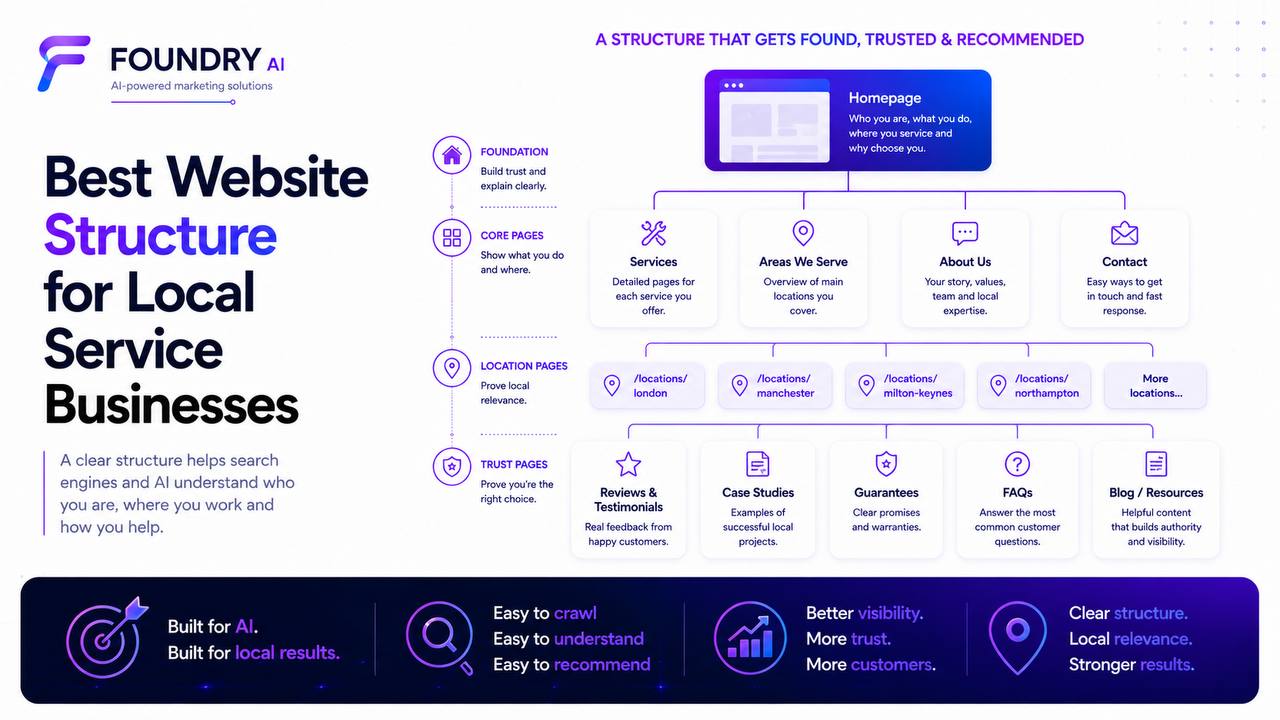
The best website structure for a local service business is simple: a clear homepage, one page for each core service, location or market pages where truthful, proof pages, FAQs, contact paths, and Insights content that answers buyer questions. Each page should have one job.
Start with page purpose
A local service website fails when every page tries to do everything. The homepage should explain the business and route people quickly. Service pages should sell one service. Insights pages should answer questions. Contact pages should make action easy.
That clarity helps visitors, search engines and AI answer systems.
The core structure
Most local service businesses need fewer page types than they think. They need better pages, not endless pages.
A strong structure usually includes a homepage, service hub, individual service pages, about page, proof or case study pages, Insights articles, FAQ blocks and a contact page.
- Homepage
- Services hub
- Individual service pages
- Market or location pages where truthful
- Proof pages
- Insights articles
- Contact page
How service pages should work
Each service page should answer the buyer’s immediate questions: what is it, who is it for, what problem does it solve, what happens next, why trust this provider, and how do I enquire?
If a service page cannot answer those questions, it is not ready to rank or convert.
Where Insights fits
Insights should not become a pile of disconnected blog posts. Each article should support a service page and link back to it naturally.
For example, an article explaining AEO should support the SEO/AEO service page. An article comparing AI receptionists with live answering should support the AI receptionist page.
What to avoid
Avoid doorway pages, duplicated location pages, vague service blurbs and blog posts with no commercial path. They create noise instead of authority.
The site should feel like a connected system. Every page should help someone understand, trust or choose the business.
Frequently asked questions
How many service pages should a local business have?
One for each real core service that customers search for and that the business wants to sell. Do not create pages for services you do not actively offer.
Should local businesses create location pages?
Only where they are truthful and useful. A location page should include real service-area relevance, proof and helpful local context.
Where should FAQs go?
Put FAQs on the relevant service pages and support them with broader Insights articles where the question deserves a fuller answer.
What is the biggest website mistake?
The biggest mistake is making the site look polished while leaving service pages vague, proof weak and conversion paths unclear.
Source notes
This article is written from Foundry AI delivery experience and checked against public search documentation where relevant.
Next step
Build a website that does a job.
We design local business websites around visibility, trust and enquiry flow, not decorative pages nobody acts on.