
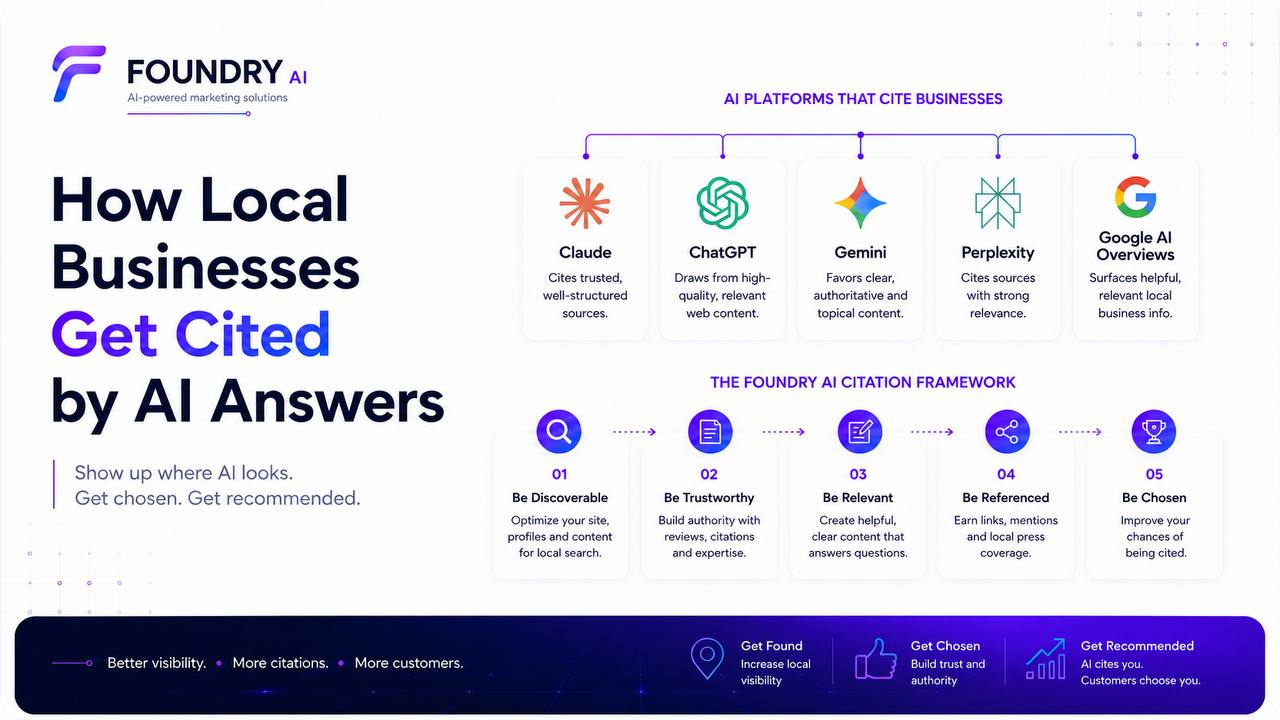
In short
- AI answer engines favour businesses whose name, services and location are consistent everywhere they appear online.
- Content written to answer specific questions directly is more likely to be quoted or summarised than general marketing copy.
- Technical basics still matter: if AI crawlers cannot access your site, they cannot cite it.
- Reviews, directories and a complete Google Business Profile carry real weight alongside your own website.
- None of this guarantees a specific citation. It improves the odds by removing the reasons an AI system might skip you.
What does it mean to be "cited" by an AI answer?
When someone asks ChatGPT, Perplexity, or Google's AI Overviews a question like "best dentist near me" or "salon that does balayage in [town]," the AI system pulls together an answer from sources it can access and trusts. Being "cited" means your business is one of the sources named, linked, or summarised in that answer.
This is different from a traditional search ranking. A search engine shows a list of links and lets the person choose. An AI answer engine picks the sources for you, often naming only a handful of options. That makes the mechanics of getting included, or being left out, more important than they were with a page-one Google ranking alone.
Why local businesses are often overlooked
Most local business websites were built to look good and describe services in broad terms: "quality service," "years of experience," "trusted by the local community." That language reads fine to a person browsing, but it gives an AI system very little to work with. AI answer engines look for specific, verifiable facts: what you do, who you do it for, where you are based, and what makes you different from the business next door.
A second common issue is inconsistency. If your business name, address, or opening hours differ slightly between your website, your Google Business Profile, and a directory listing, that inconsistency is a signal to an AI system that your information might not be reliable. It does not need to be a major discrepancy to matter.
What AI answer engines look for before citing a business
Three things tend to determine whether a local business gets included in an AI-generated answer.
Findability. The AI system needs to be able to reach your site and your listings in the first place. If your website blocks AI crawlers, or your Google Business Profile is incomplete, you are effectively invisible to the tools generating these answers.
Extractability. Your content needs to be structured so an AI system can pull a clear fact from it. A page that answers "do you take walk-ins?" or "how much does a first consultation cost?" directly and near the top of the page is far easier to extract from than three paragraphs of brand story before the useful detail appears.
Consistency and trust. AI systems weigh how consistently your business is described across your website, directories, review platforms and social profiles. Consistent name, address, phone number and service descriptions, backed by genuine reviews, build the kind of trust signal these systems rely on when they have to choose which sources to name.
Practical steps a local business can take
- Keep your business details identical everywhere. Name, address, phone number and core services should match exactly across your website, Google Business Profile, and any directory listings.
- Answer real questions directly on your site. Pricing ranges, availability, what a first visit involves, and what areas you cover are the kind of specific answers AI systems look to extract.
- Complete your Google Business Profile properly. Category, services list, hours, photos and a description that states plainly what you do and who you serve.
- Add structured data (schema markup) to your site. This gives AI answer engines a machine-readable version of your services, location and business type, reducing the guesswork.
- Keep AI crawlers welcome. Check your robots.txt file is not accidentally blocking the crawlers that AI answer engines use to read your site.
- Collect and display genuine reviews. Third-party proof, not just claims on your own site, is one of the trust signals AI systems weigh most heavily.
What this looks like across different local businesses
A salon benefits from service pages that state specific treatments, approximate pricing, and booking availability, rather than general "pamper yourself" copy, alongside a Google Business Profile with accurate categories and current photos.
A dental or clinical practice benefits from clear, factual pages on treatments offered, whether new patients are accepted, and practical details like parking or accessibility, plus consistent registration and accreditation details that reinforce trust.
An estate agent benefits from clear coverage-area pages, straightforward descriptions of the services offered (sales, lettings, valuations), and up-to-date listings that reflect what the business is actually doing right now.
In each case, the pattern is the same: specific, current, verifiable information beats generic description.
What this does not replace
Getting cited by an AI answer engine is not a substitute for the fundamentals that already drive local business growth: being genuinely good at what you do, being easy to book with, and being reasonably priced for the area. AI systems are summarising signals that already need to exist. There is no shortcut that makes an AI system recommend a business with poor reviews, inconsistent information, or an inaccessible website. The work is groundwork, not a guarantee.
Frequently asked questions
Can a local business pay to be cited by ChatGPT or Perplexity?
No. AI answer engines generate citations based on what they can find, read and trust from public sources. There is no paid placement for appearing in an AI-generated answer in the way there is for search ads.
Does having a Google Business Profile matter more than a website for AI citations?
Both matter, and they reinforce each other. A Google Business Profile is often one of the sources an AI system checks for local business facts, but a website with clear, specific content gives the AI more to work with, especially for questions that go beyond hours and location.
How long does it take to see a difference?
Technical fixes, such as correcting crawler access or fixing inconsistent business details, can take effect within a few weeks. Building the kind of clear, question-led content that AI systems tend to cite is a slower, ongoing process rather than a one-off task.
Do reviews actually affect whether AI systems cite a business?
Genuine reviews on Google, Trustpilot and similar platforms contribute to the trust signals AI systems weigh. A pattern of recent, credible reviews supports the case that a business is active and reliable.
Is this the same as SEO?
It overlaps with SEO but is not identical. Traditional SEO focuses on ranking in a list of search results. Getting cited in AI answers depends more on whether your content is structured clearly enough to be extracted and trusted, alongside the usual groundwork of accessibility and authority.
Will an AI receptionist help with this?
An AI receptionist handles inbound calls and enquiries rather than search visibility directly, but it can help keep the information a business gives out (services, availability, pricing) consistent, which supports the same trust signals AI answer engines are looking for.
Next step
Make your business easier to cite.
We can audit how your business appears in search and AI answers, then turn the gaps into a practical visibility plan.