
Short answer
Local SEO for a small business means giving Google and potential customers complete, accurate information about what you offer, where you work and how to contact you. First update your Business Profile, then improve your key service pages, and finally make the enquiry or booking action obvious.
- Keep your name, address, phone number and opening hours accurate wherever they appear.
- Build clear service and location pages that name who you help and where you work.
- Make the enquiry or booking action easy to find on every relevant page.
Start with the information Google uses
Google's official local ranking guidance says complete and accurate business information makes a profile more likely to appear in relevant local results. Google describes the main local factors as relevance, distance and prominence. You cannot control a searcher's distance, but you can give Google clearer information about your services, location and reputation.
Hello Foundry recommends checking three practical areas:
- Business information: Keep your name, address, phone number, opening hours and service area current.
- Service and location pages: Give each important service a useful page that explains what it is, who it is for and where it is available.
- Enquiry actions: Put a visible phone number, contact form or booking action on each relevant page.
You can check many of these items yourself. If you want someone to audit the details, page structure and implementation with you, our local SEO agency service is the specialist route.
Fix these three profile details first
Google's profile editing guidance identifies the address, opening hours, contact information and photos as details a verified business can keep current.
- Confirm that your current address, phone number, website and normal opening hours are correct.
- Add special hours before holidays or temporary schedule changes.
- Check that the services named on the profile match what customers can actually book or buy.
For eligible service businesses, Google's Business Profile services guidance says offerings can be grouped into categories and supported with descriptions and prices. Google also notes that a relevant service may be highlighted when a local customer searches for it.
The four-stage local visibility check
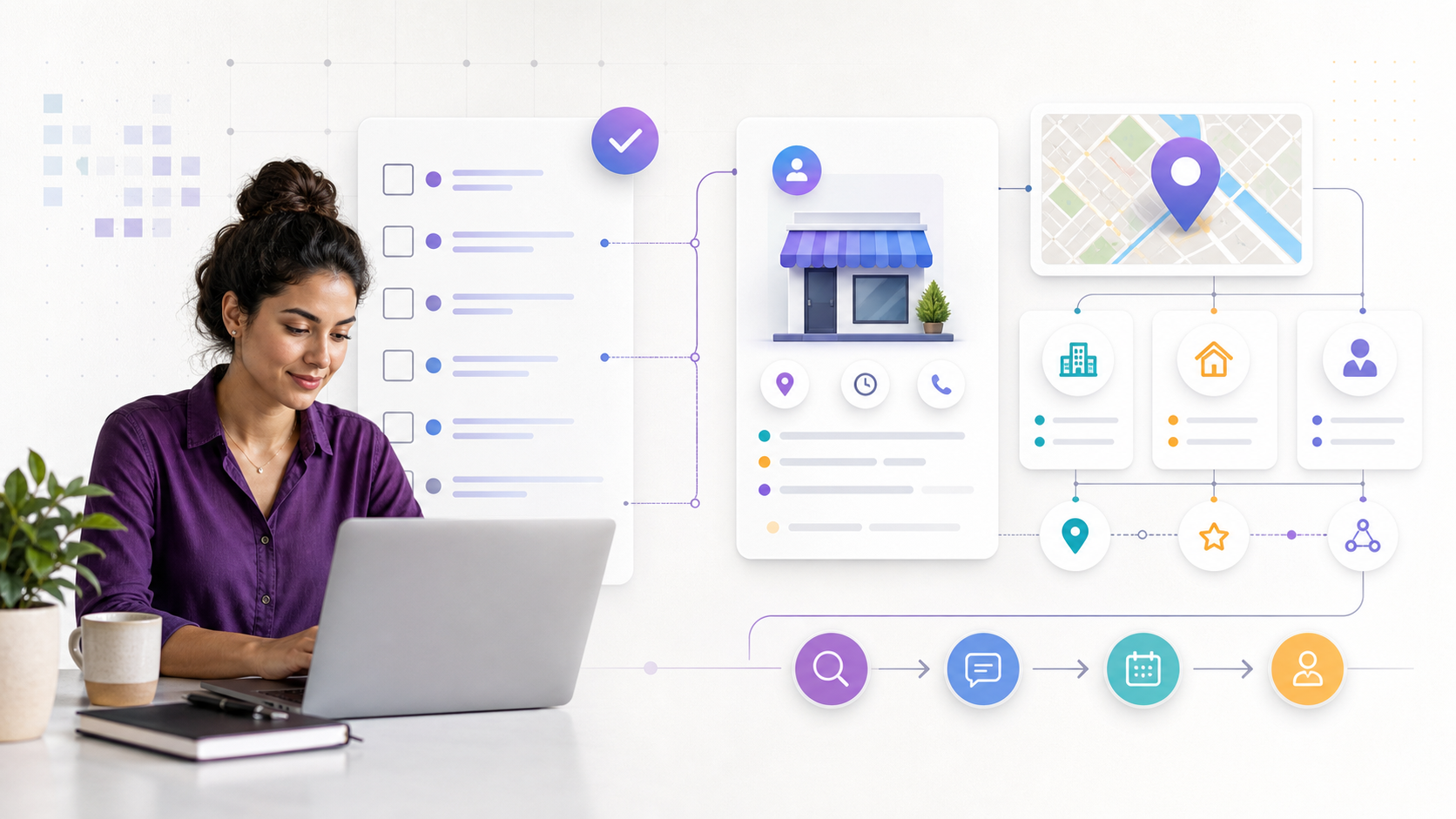
Hello Foundry uses four stages to organise the work. This is our diagnostic framework, not an externally verified ranking model.
FIND: Check that your Google Business Profile is verified and current. Use the same core name, address, phone number and opening hours on your website. Give important services and locations their own useful pages.
TRUST: Add genuine reviews, clear service detail, relevant qualifications and realistic response information. Avoid vague claims that could apply to any business.
CONVERT: Give every important page a visible next step. That might be a phone call, contact form, quote request or booking link.
RESPOND: Confirm that an enquiry has arrived and state when the customer should expect a personal reply. Automation can handle the acknowledgement while a person handles the conversation.
A concrete example: a Sheffield salon
Consider a hypothetical salon whose Google profile says it closes at 5pm, while its website says 7pm. Its homepage lists "hair and beauty" but does not name bridal styling, colour correction or the areas it serves. The booking button appears only in the footer.
- Update the hours and contact details on the Google Business Profile and website.
- Create useful pages for the services customers actually search for, using accurate Sheffield location context.
- Add the booking action beside each service description.
- Ask recent customers for genuine reviews without offering incentives or scripting the response.
This example does not promise a ranking increase. It shows how to replace conflicting and vague information with details that customers and Google can understand.
Practical update checklist
Business information
- Business name, address and phone number are current on your website and Google Business Profile.
- Opening and special hours are accurate.
- Service areas are listed clearly.
- Business category and service descriptions match what you actually offer.
Website pages
- Each important service has a useful page with a clear contact action.
- Location pages contain genuine local detail rather than duplicated town names.
- Page titles and headings describe the service and location naturally.
- Contact details are easy to find on mobile and desktop.
Content and trust signals
- FAQs answer questions customers genuinely ask.
- Claims, qualifications and prices are accurate and current.
- Internal links connect related service and location pages.
- Reviews are genuine and recent enough to help customers judge the business.
What to automate first
These priorities are Hello Foundry recommendations, not industry benchmarks.
- New enquiry acknowledgement: Confirm receipt while you prepare a personal reply.
- Review request after job completion: Make the request part of a consistent process.
- Monthly business-information check: Create a routine for finding outdated details.
- Social post from a new service page: Useful for distribution, but less time-sensitive.
Example workflow: new enquiry received
- A contact form is submitted on your website.
- A confirmation email acknowledges receipt and states your expected response time.
- An internal notification sends the enquiry details to the responsible person.
- A person reviews the enquiry and replies within the stated window.
Local SEO questions
How often should I check my business information?
Hello Foundry recommends a monthly check and an immediate update whenever your hours, phone number, address, services or booking route change. This is an operating schedule, not a Google ranking requirement.
Do I need a separate page for every town?
No. Create a location page only when you can provide useful, accurate information for that area. Thin pages that merely swap one town name for another do not help a customer decide whether you are right for them.
Can anyone guarantee a top local ranking?
No. Google's local-ranking guidance says there is no way to request or pay Google for a better local ranking. Focus on accurate information, relevant pages, genuine reputation signals and a clear customer experience.
Go deeper on local search
For a wider view of search and answer-engine visibility, read our guide to SEO for local businesses. It covers keyword signals, answer-engine optimisation and local content structure.
If you would prefer specialist help, our local SEO agency service covers audit, implementation and ongoing management for UK service businesses.
Get a practical starting point