What is the quickest way to understand local SEO vs AEO?
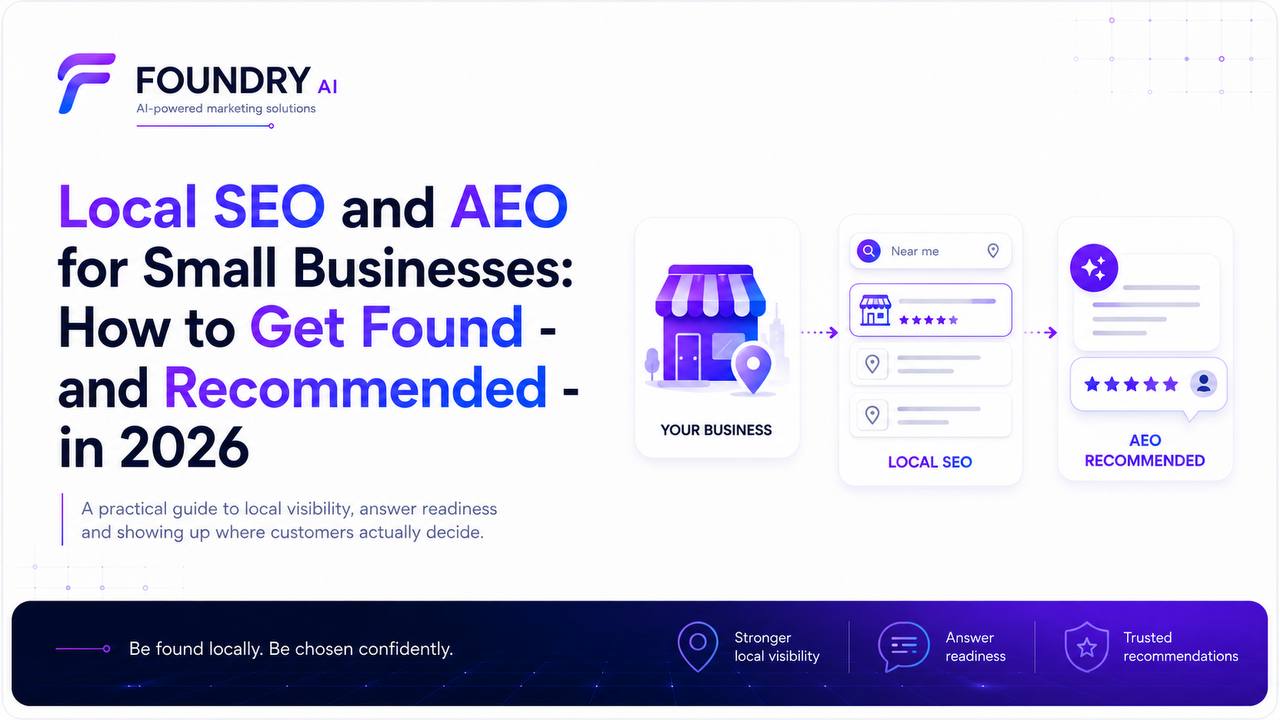
Local SEO gets your business found on Google Maps and in the local pack. AEO (answer engine optimisation) gets your business recommended when someone asks ChatGPT, Perplexity or an AI Overview a question. In 2026 you need both, because a growing share of local searches never produce a click at all.
The click is disappearing - what that means for your business
Start with the uncomfortable number. Across April to June 2026, 72-79% of UK searches for "local seo" ended with no click to any website, with an AI Overview sat on the results page every month (our data). That's not a niche quirk: SparkToro's clickstream research found 58.5% of US and 59.7% of EU Google searches produced zero clicks in 2024, and a 2026 follow-up put the US figure at 68% by early this year.
The mechanism is the AI Overview. Pew Research Center found people clicked a traditional search result 8% of the time when an AI summary appeared, against 15% when it didn't - roughly half the click-through, gone. Ahrefs' analysis of 300,000 keywords found position-1 click-through dropped 34.5% between March 2024 and March 2025, widening to around 58% by December 2025.
Amsive's study of 700,000 keywords adds a useful nuance: branded searches are largely spared - only 4.79% trigger an AI Overview, and click-through on those rises 18.68%. Generic searches are hit hardest: "best dentist near me"-style queries lose 19.98% of click-through. The better known your business name, the less this touches you - but most small businesses still rely on generic searches for new custom, which is where the ground is shifting. Read more on what AEO actually is.
Where discovery is moving - are people really asking AI for recommendations?
The honest answer: we don't have UK-specific proof yet, and we should say so. In the US, BrightLocal's 2026 Local Consumer Review Survey found the share of consumers using AI tools for local business recommendations rose from 6% in 2025 to 45% in 2026, with ChatGPT (31%) and Google AI Mode (23%) the leading tools. That's US survey data (1,002 US adults) - no equivalent UK-specific survey exists yet.
The closest UK evidence measures something narrower. GOV.UK's AI Adoption Research, surveying 3,500 UK businesses in February-May 2025, confirms 16% of UK businesses use at least one AI technology, with marketing a leading use case (72% of AI-using or AI-planning businesses) - but it doesn't ask about search behaviour. A vendor source, SearchScore, puts UK adult AI-search-tool usage at roughly 47% and claims fewer than 5% of UK SMEs have acted on AI search visibility - useful as an attributed data point, though undisclosed methodology makes it an estimate, not fact.
What we can say with more confidence is our own signal. Our data shows hellofoundry.ai recorded zero clicks site-wide but around 90 impressions across 30 queries between April and July 2026, including a cluster of AI-recommendation-shaped phrases such as "get business recommended by gemini" - evidence Google already associates this site with AI-recommendation topics, even at low ranking positions. If a search engine already connects a page to that intent, the opportunity is climbing the positions, not creating the category from nothing.
Local SEO fundamentals still decide who gets cited
Here is the sharpest, most practical finding in the whole picture. Whitespark's 2026 Local Search Ranking Factors survey of 47 local SEO experts, scoring 187 factors, found Google Business Profile signals make up 32% of ranking weight for the Local Pack and Maps results - by far the largest single category. If you've only ever done one piece of local SEO, it was probably this.
But Whitespark also scored a separate category: "AI Search Visibility", how businesses get pulled into AI Overviews and assistant answers rather than the Maps pack. There, GBP's weight collapses to 12%. On-page content (24%) and reviews (16%) lead instead. A salon or dental practice that has only ever polished its Google Business Profile is optimising for the Maps pack, not the AI answer - those are no longer the same game.
Keep your Google Business Profile complete and current - hours, categories, photos, booking links, consistent name/address/phone (NAP) everywhere it appears online. That still drives the Maps pack, but it's now the floor, not the ceiling. AEO builds on top of it; it does not replace it. See how the two disciplines fit together in our guide to SEO vs AEO for local businesses.
AEO in plain English - what does “answer engine optimisation” actually mean?
Direct answer: AEO means writing your website so an AI system can lift a clean, accurate answer straight out of it and hand that answer to a customer, with your business named as the source.
Google, ChatGPT and Perplexity are not reading your homepage for vibes - they're looking for a page that answers a specific question clearly enough to quote or summarise. In practice that means one clear answer per question rather than a page covering six topics at once, a direct answer in the first 40-60 words before any preamble, question-shaped headings matching how a customer actually phrases the question ("How much does a deep clean cost?" not "Our Pricing Philosophy"), honest FAQs addressing real booking questions, and structured data only where it's genuinely valid for the content.
A word of caution here, because a lot of advice overstates itself. This formatting is widely recommended by SEO practitioners and it's sound practice - but Google's own documentation states a page only needs to be "indexed and eligible to be shown in Google Search with a snippet" to appear in AI Overviews, with "no additional technical requirements." No controlled study has proven FAQ schema or word count causes better AI citation. The academic GEO study that introduced generative engine optimisation found content techniques - statistics, citations, expert quotes - can lift generative-engine visibility by up to 40%, but never isolated FAQ schema or answer length as the cause. Do the formatting because it helps a human and a machine use your page, not because it's a guaranteed switch.
One claim to leave alone entirely: some vendors claim Reddit content receives several times more AI citations than average, often quoting a "3.4x" figure. This multiplier is not independently verified, and the trend is too volatile to build a strategy on - Semrush tracked ChatGPT's Reddit citation rate swing from around 60% of responses to around 10% within six weeks in autumn 2025, and a separate Ahrefs snapshot found Reddit didn't crack the top 10 sources for ChatGPT or Perplexity that month. Chasing a volatile platform effect distracts from the fundamentals you control. Our guide to how local businesses get cited by AI answers walks through the process.
The “money questions” method - what should you actually write?
Direct answer: list every question a customer asks you before they book, then publish one clear, honest answer to each one on your own website.
This is the highest-leverage exercise in this article, and it costs nothing but time. Sit down - ideally with whoever answers your phone or front desk - and write out every question a prospective customer has ever asked before booking. Not the questions you wish they asked. The real ones: "How much is a full colour?" "Do you accept NHS patients?" "What's the average time to sell in this postcode?" "Do you take walk-ins on a Saturday?"
Most businesses have 25-50 of these questions in total. Publish one clear answer per question - as an FAQ page, a short article, or a section on the relevant service page. Answer plainly, in the business's own voice, in the first couple of sentences, then add detail after. This is the practical core of AEO: pre-answering the exact questions an AI assistant is trying to answer on your behalf, so it has your version to draw on instead of a directory site's or a competitor's. Our guide on getting your business recommended by AI goes deeper on prioritising which questions to tackle first.
What to measure - how do you know if any of this is working?
Direct answer: measure impressions before clicks, and track whether AI engines actually name you when asked the money questions - clicks will lag behind both.
The old scorecard - rankings and click-through rate - undercounts what's happening now. A page can be doing real work, appearing in AI Overviews and read by assistants, while showing zero clicks in your analytics. That's not necessarily failure. Check Search Console for impressions on question-shaped queries, even at position 60-90 - a low position with impressions means the page exists in the index for that intent, a different problem to starting from nothing.
Alongside that, run your "money questions" through ChatGPT, Perplexity, Google AI Mode and Gemini every few weeks and note whether your business gets named, and what's said. This is manual and unglamorous, but currently the most honest measurement available. Treat clicks and enquiries as the lagging indicator, not the first signal to watch.
If this sounds like a lot to track alongside running a business, that's the gap our SEO and AEO service is built to close. See pricing for what that costs.
The 30-day local visibility sprint
A practical checklist to work through in one month, roughly a week at a time.
Week 1 - fix the foundations
- Audit your Google Business Profile: hours, categories, services, photos and booking link all current.
- Check name, address and phone number (NAP) match exactly across your website, GBP and any directories.
- Confirm every location you operate from has its own page, not just a line on the contact page.
- If your website itself needs rebuilding first, Hello Foundry's free website programme covers that at no cost.
Week 2 - build the money-questions list
- Ask front-desk staff for the 10 questions customers ask most before booking.
- Add another 15-40 from booking-call notes, emails and past reviews.
- Group them by topic: pricing, process, policies, availability.
Week 3 - write the answers
- Publish a direct answer (40-60 words) at the top of each relevant page or FAQ entry, in plain language.
- Rewrite headings as questions, matching how customers phrase them.
- Add or update an FAQ section on your two or three highest-traffic service pages.
Week 4 - check and measure
- Run your top 10 money questions through ChatGPT, Perplexity and Google's AI Mode. Note where you're named, and where a competitor is named instead.
- Check Search Console for impressions, not just clicks, on question-shaped queries.
- Add structured data only where it's genuinely valid.
Frequently asked questions
Do I need to choose between local SEO and AEO?
No. Local SEO and AEO are not competing strategies - AEO builds on local SEO fundamentals rather than replacing them. Your Google Business Profile, reviews and consistent NAP still drive the Maps pack. On-page content and reviews carry more weight for AI Search Visibility specifically, according to Whitespark's 2026 Local Search Ranking Factors survey. Do both, in that order.
Is AEO just a rebrand of SEO?
Not quite. The techniques overlap heavily, but the target differs. SEO optimises to rank in a list of links a human scans. AEO optimises so an AI system can lift one clean answer and hand it to the customer directly, often without a click at all.
Will FAQ schema markup get my business into AI Overviews?
Not on its own. Google's documentation says a page needs to be indexed and eligible to show a normal search snippet, nothing more, to be considered for AI Overviews. Clear, question-led formatting helps readers and machines alike, but no study has proven schema itself causes better citation.
How many questions should I actually answer on my website?
Most small businesses end up with 25-50 real money questions once front-desk staff, booking notes and past enquiries are pulled together. Start with the ten you're asked most often, then work through the rest over the following weeks.
Should I worry about losing clicks to AI Overviews?
It depends on the type of search. Branded searches, where people are already searching your business name, are largely unaffected, and click-through on branded queries actually rises slightly when an AI Overview appears, per Amsive's 2025 study of 700,000 keywords. Generic, informational searches like 'best salon near me' are where the click loss concentrates, which is exactly where AEO work matters most.
How do I know if AI assistants already recommend my business?
Ask them directly. Type your money questions into ChatGPT, Perplexity, Google AI Mode and Gemini and note whether your business is named, and what's said. There's no mature third-party tracking tool for this yet, so manual, regular checking is the most reliable method.
Source notes
This article draws on first-party Similarweb and Search Console data for hellofoundry.ai, plus public research and Google's own documentation where relevant.
Next step
Get a clear read on where you stand.
A free Spark audit gives you a plain-English read on your local SEO foundations and your AI-answer visibility, with a prioritised list of what to fix first.