
The short answer
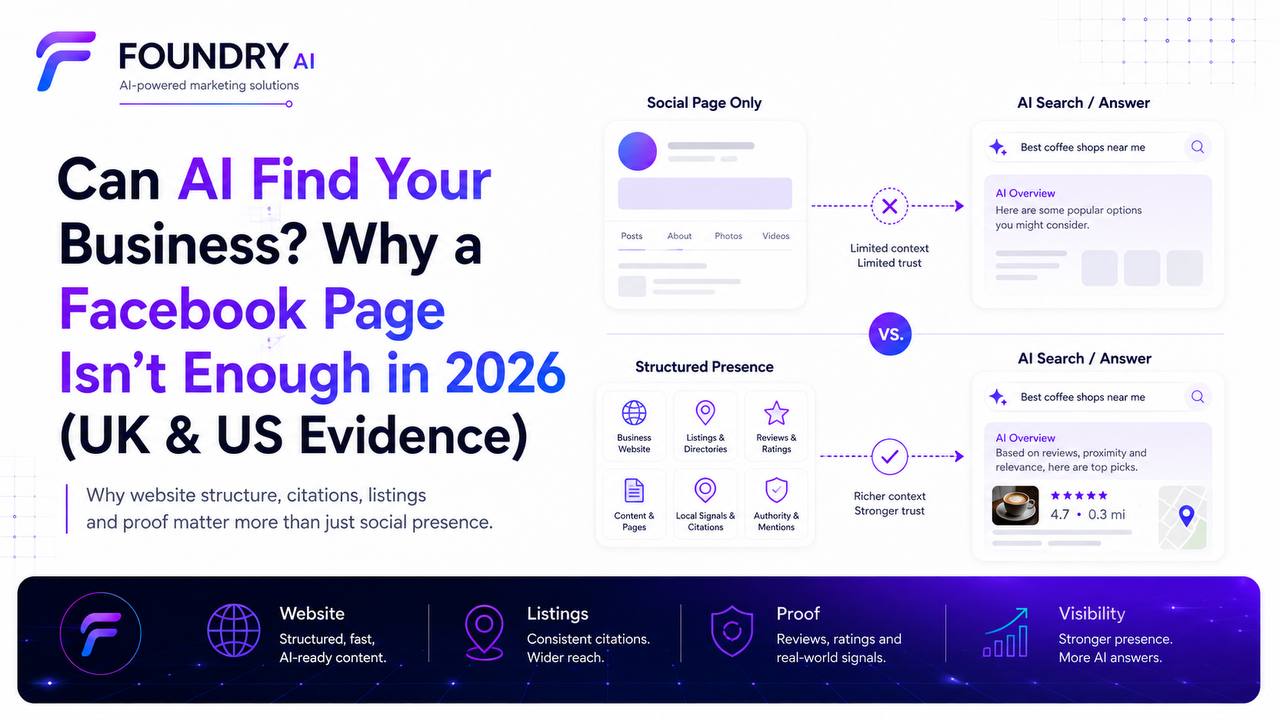
For most local businesses, the honest answer is: probably not well. AI assistants like ChatGPT and Perplexity mostly can't read Facebook or Instagram pages — those sit behind a login wall crawlers can't pass — and for local recommendations they increasingly pull from licensed data like Yelp, not social profiles. To be found and cited, you need a fast, crawlable website you own.
That's not a scare story. It's a straightforward description of how these systems work in 2026, and it has a straightforward fix. This piece sets out the evidence, in plain terms, for UK and US business owners who want to know whether their current web presence actually works in the age of AI search — and what to do if it doesn't.
Why this matters now
Ten years ago, "getting found online" mostly meant getting found by Google. That's no longer the whole picture. AI assistants and answer engines have moved from a curiosity to a default habit for a huge number of people, and they're increasingly the first stop for exactly the kind of question that used to send someone straight to Google: "best plumber near me," "is this restaurant open Sunday," "who does wedding photography in Leeds."
The scale is worth sitting with for a moment. ChatGPT reached 900 million weekly active users by February 2026, according to OpenAI. Google's AI Overviews — the AI-written summaries that now appear above traditional search results — reach more than 2 billion monthly users, a figure Google's parent company Alphabet confirmed on its Q2 2025 earnings call. Perplexity, a smaller but fast-growing competitor built specifically for answer-style search, was handling around 780 million queries a month by May 2025, according to its CEO.
None of this is fringe behaviour any more. It's mainstream search behaviour, running in parallel with — and increasingly ahead of — a traditional Google search.
And the shift isn't just about where people ask questions. It's about where they get their answers for local businesses specifically. BrightLocal's 2026 Local Consumer Review Survey found that the use of ChatGPT and similar AI tools for local business recommendations jumped from 6% the year before to 45% — making AI the third most common source of local recommendations, behind only Google and Facebook itself. That's a genuinely fast shift, and it means the businesses that show up well in AI answers are starting to have a real edge over the ones that don't.
How AI assistants actually find and cite local businesses
Here's the part that surprises most business owners: AI assistants don't work the way people assume. They're not simply "reading the internet" in real time and picking whichever page looks best. For local business information specifically, a lot of what ChatGPT and similar tools surface comes from licensed, structured data partnerships rather than from crawling and interpreting a business's own website or social pages from scratch.
The clearest example: in mid-2026, OpenAI struck a data-licensing deal with Yelp, giving ChatGPT access to Yelp's review and listings database — around 330 million reviews covering roughly 8 million business listings. That deal isn't exclusive; Yelp has separately licensed similar data to other platforms. The practical effect is that when someone asks ChatGPT for a recommendation, there's a good chance the answer is being assembled, at least in part, from a structured business listing rather than from an AI system independently reading a company's homepage.
Google's AI-generated answers work similarly for local queries, leaning heavily on Google Business Profile data — the same listing system that's powered Google's local pack and Maps results for years.
The takeaway for a business owner is simple: being findable by AI increasingly depends on having your business represented in the structured data these systems already trust — and having a real website that AI can independently crawl, verify, and cite when someone asks a more specific question than a directory listing can answer.
Why a Facebook or Instagram-only presence doesn't work for AI
This is the part of the picture that catches a lot of small businesses out. If your entire online presence is a Facebook Page or an Instagram profile — no separate website — you are, in practice, largely invisible to the AI systems doing this recommending.
The reason is structural, not a conspiracy. Public Facebook and Instagram pages sit behind a login wall that cuts off anonymous access after a brief preview — you can see a snippet, but the full content typically requires a Meta account to view properly. AI retrieval systems, including the crawlers that power ChatGPT's and Perplexity's real-time answers, generally can't authenticate into a platform the way a logged-in human user can. If a crawler can't get past that wall, it can't read what's on the other side of it — and it certainly can't cite it.
This isn't a new problem invented by AI. It's the same reason a Facebook-only business has always struggled with traditional Google search too. What's changed is the stakes: as more discovery moves to AI assistants that increasingly lean on licensed, structured data for local answers, a business with no independent, crawlable website has fewer and fewer ways to be found by either system.
To be clear about what we know for certain here and what we don't: the pattern of Meta pages being difficult for outside crawlers to fully access is well documented and consistent with how these platforms have long operated. What we'd stop short of claiming is a specific, permanent technical rule that will never change — platforms adjust access policies over time, and any business relying entirely on a Meta page should treat that as a genuine risk today, not assume it will always be the case.
There's a second, separate risk worth naming here too: you don't own a Facebook Page the way you own a website. Reach depends on an algorithm you don't control, and accounts can be restricted or disabled with little warning. In April 2025, the Leicester Gazette — a local news outlet — had its Facebook group and admin account disabled without a clear explanation, cutting off its second-largest source of readers overnight, during a period of local elections. That's a real, documented example of what platform dependency actually costs a business when it goes wrong, independent of any AI-search angle at all.
What AI crawlers can and can't read — the JavaScript problem
There's a second, more technical reason a lot of business websites are less AI-visible than their owners assume, and it has nothing to do with Facebook. It's about how the website itself is built.
Many modern websites — including plenty built on WordPress with heavy plugin stacks, and many custom-built sites — rely on JavaScript to load and display their actual content in the browser. A human visitor's browser runs that JavaScript automatically, so the page looks fine. But a lot of AI crawlers don't run JavaScript at all. They fetch the raw HTML a server sends back, and if the real content only appears after JavaScript executes, the crawler sees a mostly empty page.
This isn't a guess. A 2024 analysis by Vercel and MERJ examined more than 500 million requests from OpenAI's GPTBot crawler and found zero evidence of JavaScript execution. GPTBot did occasionally fetch JavaScript files — in around 11.5% of requests — but never ran them. Anthropic's ClaudeBot fetched JS files slightly more often, in about 23.84% of requests, again without executing them. Google's Gemini is something of an exception, because it can piggyback on Google's own search infrastructure, which does render JavaScript. But across the wider set of AI crawlers, the researchers estimated that roughly 69% simply cannot render JavaScript-dependent content at all.
Put plainly: if your website's actual content — the words describing what you do, who you serve, and why someone should choose you — only shows up after JavaScript runs, a large share of AI crawlers are seeing a blank or near-blank page, no matter how good that content is to a human visitor.
What this means practically for a small business
Bringing this together, there are really two separate but related visibility gaps to close:
- The "no independent website" gap. If a Facebook or Instagram page is the only web presence a business has, it's largely invisible to AI crawlers and dependent on structured listings (Yelp, Google Business Profile, and similar) to be found at all — and even then, only for the kind of basic factual questions a directory can answer.
- The "AI can't read my site" gap. If a business does have a website, but its key content is locked behind JavaScript that doesn't render for most AI crawlers, that website may be doing far less AI-visibility work than its owner assumes.
The fix for both is the same underlying principle: a fast, genuinely crawlable website, built so that its real content — services, location, pricing, credibility signals — is present in the raw HTML a crawler receives, not hidden behind client-side scripting. Alongside that, keeping structured listings (Google Business Profile, Yelp, and similar) accurate and complete gives AI systems a second, trusted route to your business information.
What we don't yet know for certain
In the interest of giving a straight answer rather than a sales pitch, it's worth being upfront about the limits of what's confirmed here. Platforms change access rules over time, and the precise technical configuration of any one platform's crawler access can shift without much public notice. What's documented and consistent, as set out above, is the pattern: login-walled social pages are hard for outside crawlers to read, and a majority of AI crawlers don't execute JavaScript. Treat that as the current, evidenced state of play — and a good enough reason to build a proper website — rather than a permanent, unchangeable law of the internet.
It's also worth being clear that none of this is a guarantee. Having a fast, crawlable, well-structured website improves your eligibility to be found and cited by AI systems. It doesn't guarantee a citation, a ranking, or a mention — no legitimate agency can promise that, and you should be sceptical of anyone who does.
What to do next
If your business currently runs entirely on a Facebook or Instagram page, or your website is slow, JavaScript-heavy, or otherwise hard to read, the practical next step is straightforward: get a proper website built the right way, and make sure your structured listings are accurate. Hello Foundry builds businesses a complete website — or migrates an existing WordPress site — for free, with free hosting for life and no obligation to buy anything else. You can read exactly what's included and what "free for life" actually means.
Frequently asked questions
Can ChatGPT read my Facebook Page?
Generally, no — not reliably. Public Facebook and Instagram pages sit behind a login wall that cuts off full anonymous access, and AI crawlers typically can't authenticate the way a logged-in human can. This means a Facebook-only presence is largely invisible to AI assistants, even though it's visible to human visitors browsing normally.
Does my business need a website if I already have good social media?
For AI visibility specifically, yes. Social profiles aren't reliably crawlable by AI systems, so a business relying only on social media has few routes to being found by AI assistants beyond appearing in a licensed data source like Yelp or Google Business Profile.
Will building a good website guarantee my business shows up in ChatGPT or Google's AI Overviews?
No, and any agency promising that isn't being straight with you. A fast, crawlable, well-structured website improves your eligibility to be found and cited — it doesn't guarantee it. AI systems are opaque, change frequently, and weigh many factors.
Why can't AI crawlers just read my website the way a person does?
Because a large share of AI crawlers don't execute JavaScript. If your website's real content only appears after JavaScript runs in a browser, those crawlers may only ever see the raw, mostly empty HTML that loads before the script runs — even though a human visitor sees the finished page just fine.
Is this the same problem as ranking on Google?
Related, but not identical. Googlebot has always been better at rendering JavaScript than most AI crawlers. But the underlying principle — that content needs to be genuinely accessible in the page's raw HTML, not just visible to a human browser — has mattered for traditional SEO for years, and it now matters for AI visibility too.
Evidence sources used
The source notes supplied with this article identify the following evidence used in the draft.
- OpenAI, weekly active users, via TechCrunch, 27 February 2026
- Alphabet Q2 2025 earnings call (Sundar Pichai), July 2025 — AI Overviews 2B+ monthly users
- Aravind Srinivas, Bloomberg Tech Summit via TechCrunch, 5 June 2025 — Perplexity ~780M queries/month
- BrightLocal Local Consumer Review Survey 2026, published 11 February 2026 — AI recommendation use 6% → 45%
- OpenAI/Yelp data licensing — Axios, ~23 July 2026; confirmed in Yelp's February 2026 results (330M reviews, 8M listings)
- Vercel/MERJ, "The Rise of the AI Crawler," 2024 — 500M+ GPTBot fetches, zero JS execution; GPTBot 11.5%/ClaudeBot 23.84% JS-file fetch rate; ~69% of AI crawlers can't render JS
- Leicester Gazette Facebook account disabling, April 2025 (documented case)
Free Website Programme
A properly branded small-business website. £0 build. £0 supported static hosting.
You buy and own the domain. Hello Foundry builds the agreed standard site, including SEO and AI-readable foundations, and hosts it for £0 while it remains on our supported static stack.