
Claude has become one of the most widely used AI assistants for research, comparisons, and buying decisions. Like every AI search engine, it answers by pulling from - and citing - sources across the open web. For brands, that raises a practical question: when Claude builds an answer, which kinds of sources does it actually reach for, and which does it ignore?
Recent research analysed 379,321 Claude citations across 16,406 domains over the course of a month, sorting each one into 11 source categories. The headline finding: Claude's citations are overwhelmingly brand-dominant, spread thinly across a long tail of domains, and almost entirely free of social media. That behaviour is different from other AI engines, and it changes how brands should approach getting cited.
Key findings at a glance
- Reddit doesn't get cited by Claude. Social platforms made up just 0.9% of all citations, and Reddit accounted for zero of them. LinkedIn alone took 43.1% of the (small) social share.
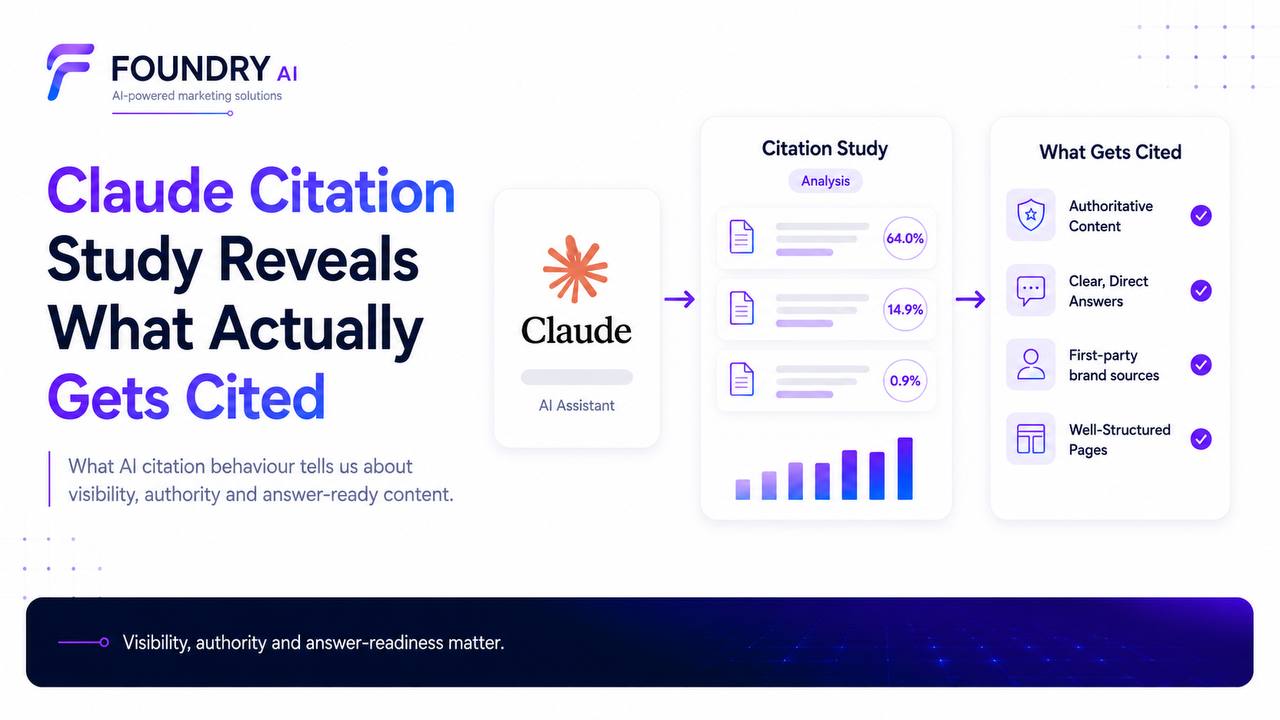
- Brand websites dominate. Company and product domains made up 64.0% of all citations - more than four times the next-largest category, News and Media, at 14.9%. Claude leans on first-party brand content far more than a traditional Google search does.
- Citations spread across a long tail. The top 10 domains accounted for just 9.5% of all citations, and 32.9% of cited domains were cited only once. There's no small club of dominant sources controlling the answers.
- Breadth and depth split by source type. Brand sources win on breadth (10,842 distinct domains cited). Social, Encyclopedia, and Video sources win on depth - a small number of trusted domains getting cited repeatedly, at a rate of roughly 96 citations per domain for social sources.
- The pattern holds steady. Across the study period, no source category moved by more than about one percentage point week to week. What works today is likely to still work next month.
Why Claude matters as its own AI search channel
Getting cited in an AI answer matters more than ranking in a traditional search result, because the answer sits directly in the interface and clicks fall away.
But "AI search" isn't one channel with one set of rules. Comparative research on Claude and ChatGPT found only 13% domain overlap between what the two engines cite, dropping to around 4.2% overlap at the individual URL level. ChatGPT leans toward community content like Reddit. Claude leans toward brand and product pages. These are two separate channels with two different sets of winners.
The practical question for any business is which engine its buyers are actually using. That choice between ranking and being cited is the heart of SEO vs AEO for local businesses. Claude skews toward research, comparison, and B2B decision-making. If that's where your audience sits, that's where the optimisation effort belongs - focused on the brand-dominant, reference-grade content Claude rewards. Watching ChatGPT citation data alone leaves a brand blind to what's happening on Claude.
What types of sources does Claude cite most?
Sorted by citation volume, the source categories are strikingly top-heavy. One category - brand websites - accounts for nearly two-thirds of everything Claude cites. Everything else is competing for what's left.
| Source category | Share of citations | Unique domains |
|---|---|---|
| Brand | 64.0% | 10,842 |
| News / Media | 14.9% | 1,688 |
| Blogs / Personal sites | 5.4% | 1,041 |
| Other | 3.7% | 1,162 |
| Education | 2.7% | 518 |
| Government / NGO | 2.4% | 596 |
| Unclassified | 2.3% | 221 |
| Encyclopedia | 2.1% | 142 |
| Community / Forum | 1.3% | 139 |
| Social media | 0.9% | 37 |
| Video | 0.3% | 20 |
"Unclassified" is largely country-code domains (.co.uk, .com.au) that couldn't be resolved to a single category.
1. Brand domains dominate - but no single brand owns the space
At 64.0% of all citations, brand domains - company, product, and service websites - are the backbone of Claude's answers. When Claude explains a product category, compares options, or answers a "how does X work" question, it overwhelmingly reaches for first-party content published by the companies themselves.
That dominance is spread thin, not concentrated. Brand citations span 10,842 distinct domains, and the single most-cited brand domain accounts for under 3% of brand citations overall. The top 10 brand domains combined make up only around 13% of the category. No brand owns Claude's attention. The field is open and contestable - good news for challengers, a warning for incumbents who assume their existing authority carries over.
What this means in practice: a company's own website is its highest-leverage AI visibility asset. Product, solution, and comparison pages that read like authoritative reference material - not thin marketing copy - are the most direct route to a Claude citation. The same groundwork underpins how local businesses get cited by AI answers.
2. News and media is a distant but meaningful second
News and Media is the second-largest category at 14.9%, and it actually cites more per domain (34 citations per domain, on average) than the Brand category does. Claude tends to reach for specialist and authoritative publications rather than general-interest headlines, with financial and business-news outlets appearing repeatedly. Earned coverage in credible, topically relevant publications remains a real route into Claude's answers - it reinforces first-party content rather than replacing it.
3. Reference sources punch above their weight
Encyclopedia (2.1%), Education (2.7%), and Government/NGO (2.4%) sources are small by volume, but they behave like trusted anchors: each is concentrated in a handful of domains cited over and over. Encyclopedia sources average 56 citations per domain. These reference-grade sources are what an answer engine reaches for when it needs a definitional or authoritative backstop. Most brands won't "win" these categories outright, but they show what "citeable" looks like to Claude: clear, structured, factual, and well-sourced.
The long tail: citations spread across thousands of sources
If brand dominance is the first surprise, the distribution beneath it is the second. Claude is not a system that recycles the same handful of authority sites for every answer.
| Top N domains | Citations | Share of all citations |
|---|---|---|
| Top 10 | 35,924 | 9.5% |
| Top 25 | 68,540 | 18.1% |
| Top 50 | 101,560 | 26.8% |
| Top 100 | 135,899 | 35.8% |
| Top 500 | 227,355 | 59.9% |
| All 16,406 domains | 379,321 | 100% |
It takes roughly 500 domains to reach 60% of all citations, and 32.9% of cited domains were cited exactly once. Claude's sourcing is unusually distributed compared with traditional search, where a small set of high-authority sites tends to dominate.
What this means: a business does not need to be a top-10 domain to be cited. A focused page that answers one specific question clearly can earn a citation regardless of overall domain authority. The trade-off is that breadth of well-structured content matters - every additional page is another chance to match a real query.
Where social media fits - and mostly doesn't
This is where Claude diverges most sharply from conventional AI-visibility advice. Social media is not a meaningful citation source for Claude. Across the full dataset, social platforms accounted for just 0.9% of citations - roughly 3,558 out of 379,321. Any AI strategy that assumes Claude surfaces social posts the way ChatGPT or Perplexity sometimes do is working from the wrong assumption.
| Rank | Platform | Share of social citations |
|---|---|---|
| 1 | 43.1% | |
| 2 | 14.1% | |
| 3 | TikTok | 9.1% |
| 4 | ResearchGate | 6.7% |
| 5 | 6.7% | |
| 6 | 3.3% | |
| 7 | SlideShare | 3.1% |
| 8 | X (Twitter) | 1.6% |
| - | 0% |
The striking absence: Reddit and X
The most newsworthy finding here is what's missing. Reddit - which other published AI-citation research has found to be one of the most-cited social sources on engines like Perplexity and ChatGPT - was cited zero times by Claude across the entire dataset. X (Twitter) appeared just 56 times, about 1.6% of an already tiny social slice. A Reddit-first or X-first AI visibility playbook simply doesn't transfer to Claude.
What social content Claude does cite skews professional
The little social content Claude does cite is professional and document-oriented. LinkedIn alone accounts for 43.1% of social citations, and professional or knowledge platforms like ResearchGate and SlideShare punch above their weight relative to consumer-first networks like Instagram and TikTok. Long-form, profile-and-document content makes it into Claude's answers. Ephemeral feed content largely doesn't.
The practical read: right-size social investment for Claude specifically. If a business invests in social at all with Claude visibility in mind, a content-rich LinkedIn presence and authoritative documents outperform chasing Reddit threads or viral short-form video. That energy is generally better redirected toward the first-party brand content that already makes up 64% of what Claude cites.
Claude's citation behaviour is stable over time
A fair question about any monthly snapshot is whether the pattern holds or drifts. Here, the category mix stayed remarkably steady. Comparing the first five days of the study window with the last five, no category moved by more than roughly one percentage point. Brand held near 64% throughout. News and Media drifted down slightly. Social stayed near 1%. Daily citation volume ran in a consistent band of roughly 20,000 to 24,000 citations per day.
That stability matters for planning. Because Claude's sourcing behaviour is consistent week to week, optimisation decisions made now are unlikely to be invalidated by short-term volatility.
Five things to do about it
- Win with first-party, reference-grade content. Brand domains are 64% of Claude's citations, and no single brand dominates the category. Treat your own site as the primary battlefield - build product, solution, comparison, and "how it works" pages that read like references, not brochures. For the local-business version of these steps, see how to get your business recommended by AI.
- Structure pages so machines can extract them. The source categories Claude cites most heavily per domain - encyclopedic, educational, reference - share one trait: clean structure. Use descriptive headings, concise summaries, well-formed lists and tables, and explicit definitions. Make it easy for an answer engine to lift a specific, self-contained passage.
- Compete on breadth, not just a flagship page. With a third of cited domains appearing only once, coverage matters. A library of focused pages, each answering one specific question, creates far more surface area for matching real prompts than a single comprehensive page can.
- Right-size social investment. For Claude, social media is a rounding error, and Reddit and X are effectively absent. Where social is worth maintaining at all, professional and document-style content - LinkedIn in particular - is what actually gets picked up.
- Build third-party authority signals. News and Media is Claude's second-largest category, weighted toward credible, specialist publications. Earned coverage in topically relevant outlets complements first-party content and adds independent validation.
Frequently asked questions
Does Claude cite Reddit?
No. Across a month-long dataset of 379,321 citations, Reddit was cited zero times by Claude - a sharp contrast with engines like Perplexity and ChatGPT, where Reddit is a heavily cited source.
What percentage of Claude's citations come from company websites?
Brand - meaning company, product, and service domains - accounted for 64.0% of all Claude citations in the study, more than four times the next-largest category.
Do I need a high-authority domain to get cited by Claude?
Not necessarily. The top 10 cited domains made up only 9.5% of all citations, and nearly a third of all cited domains were cited just once. A focused page answering a specific question can earn a citation regardless of overall domain authority.
Is social media worth investing in for AI visibility on Claude?
Only in a limited, targeted way. Social platforms accounted for just 0.9% of Claude's citations overall, and what little social content does get cited skews toward LinkedIn and other professional, document-style platforms rather than consumer feeds.
Does Claude's citation behaviour change often?
No. Category shares moved by no more than about one percentage point across the study window, suggesting the pattern is stable enough to plan content strategy around.
Next step
Find out if you're actually being cited.
Most of this comes down to one question: is your business showing up when people ask AI assistants for recommendations in your category? You can check for free, across every major AI engine - not just Claude - at amiaivisible.com. Enter your brand and see whether ChatGPT, Claude, Gemini, Perplexity, and the others are citing you, or citing someone else instead.