
The short answer
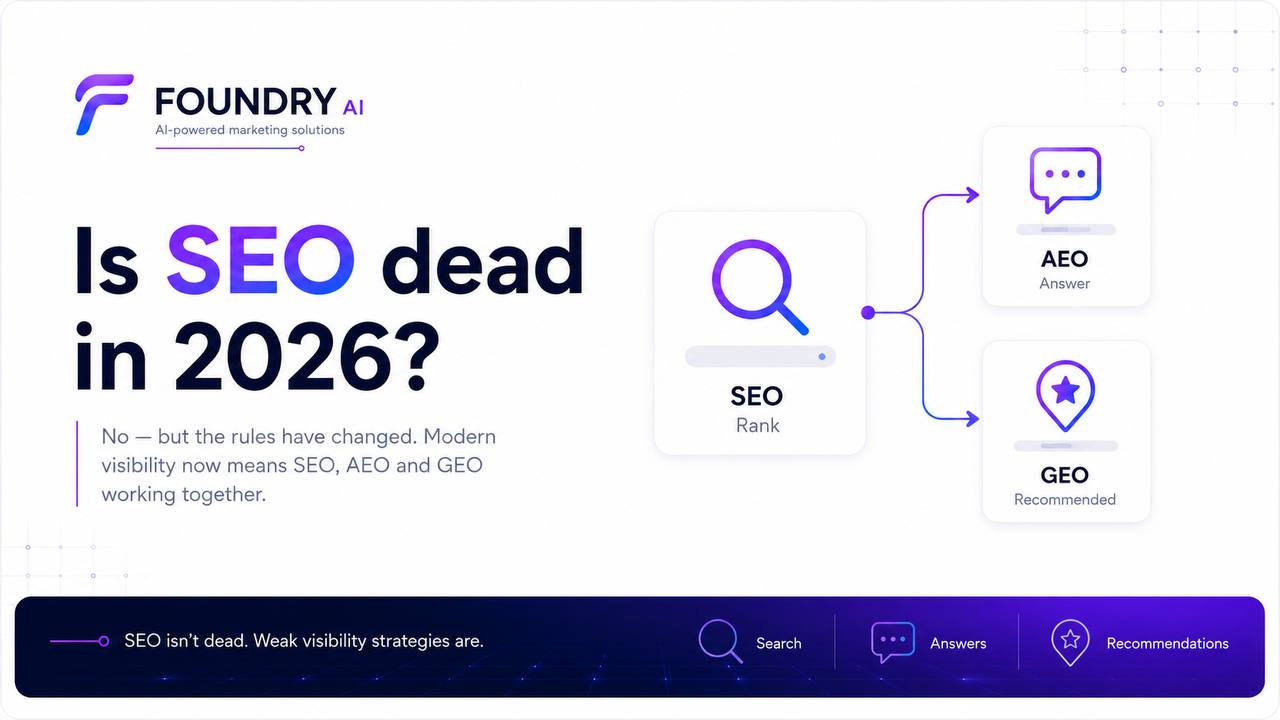
No, SEO is not dead in 2026, but it is changing. People still search, so ranking still matters. What changed is that a growing share of searches are answered by AI directly, so being cited by AI answers now sits alongside ranking. SEO is evolving into search plus answer engine optimisation, not disappearing.
Why people say SEO is dead
The claim is not baseless this time. When someone asks an AI assistant a question, it often answers directly, on the page, without sending a click to anyone. If your whole model was ranking first for a search and collecting the click, that model looks shakier than it did. Add the noise of thin, mass-produced content flooding results, and it is easy to conclude the game is over.
But "the click behaviour changed" is not the same as "being found no longer matters." Those are very different claims, and only the first is true.
What actually changed
Two things moved, and neither kills SEO:
- Where the answer appears. More answers now surface inside an AI result rather than as ten blue links. The destination shifted; the need to be the trusted source did not.
- What earns visibility. Clarity, structure and proof matter more than keyword density ever did. AI answer engines read the open web and cite sources, so the businesses they cite are the ones with clean, answer-ready pages.
The core job of SEO, being the answer people and engines trust, is exactly the same. The surface it plays out on is what evolved.
What still works
Plenty. People still type queries into search and click results, especially for local, high-intent searches like finding a nearby service. Google still returns links, maps and profiles. A clear, well-structured, credible website still wins, and it now does double duty: it earns rankings and it feeds the AI answers that cite the open web. Our own research into what gets cited by AI found brand websites make up 64% of citations, which means your own pages are more valuable now, not less. If your website needs rebuilding before it can do that job, our free website programme covers the build at no cost.
SEO is evolving into search plus AEO
The honest framing is not "SEO is dead" but "SEO grew a second half." Traditional SEO wins the ranking and the click. Answer engine optimisation, or AEO, wins the direct answer and the AI recommendation. You may also see this recommendation work called generative engine optimisation, or GEO. The labels overlap; the practical job is making your business clear, trustworthy and easy for an AI system to cite. If the terms are new, start with what AEO is, then see where the line falls in SEO vs AEO for local businesses.
For a local business the practical takeaway is simple: do not cut SEO, extend it. The site you optimise to rank is the same site an AI answer reads to decide whether to recommend you. Cutting one to fund the other leaves a gap a competitor fills.
What to do now
Stop asking whether SEO is dead and start checking whether you are visible in both places: the search results and the AI answers. Test how AI assistants describe your business and your competitors, tighten the pages that answer real buyer questions, and add the structure that lets a machine cite you. If you want that done for you, our SEO and AEO services cover both, or book a visibility call and we will show you where you are missing. See pricing for what that costs.
Frequently asked questions
Is SEO dead in 2026?
No, SEO is not dead in 2026, but it is changing. People still search, so ranking still matters. What changed is that a growing share of searches are answered by AI directly, so being cited by AI answers now sits alongside ranking. SEO is evolving into search plus answer engine optimisation, not disappearing.
Is SEO dead or evolving?
Evolving. The core job, being the trusted answer to what people want, has not changed. The surface has: some answers now appear inside AI results rather than a list of links. Businesses that add answer engine optimisation to their SEO keep winning, while those that stop investing quietly disappear from both.
Will AI replace SEO?
No. AI changes where answers appear, not whether businesses need to be found. AI answer engines still read the open web and cite sources, and our research found brand websites make up 64% of what they cite. Optimising those pages is still the work, so SEO widens to include AI visibility rather than being replaced.
What is replacing traditional SEO?
Nothing is replacing it outright. Traditional SEO is being joined by answer engine optimisation (AEO), which structures pages so AI answers can cite them. For a local business the two now run together: SEO wins the click on a results page, AEO wins the direct answer and the recommendation.
Source notes
Written from Foundry AI delivery experience and Foundry's own citation research. Checked against public search documentation where relevant.
About the author
Jason Sibley is the founder of Foundry, the company behind Hello Foundry. He sets strategy and direction, keeping the work tied to real client outcomes rather than activity. His background spans sports marketing, technology and Web3, building engagement and growth systems for clubs, brands and platforms. Alongside Foundry he runs Cleo Group and Zenko Protocol, and he writes much of the company's thinking on AI agents, marketing and the economics of AI. Foundry runs on the same connected, agent-driven model it builds for the local businesses it works with. More on the about page.
Next step
Check whether you are visible in search and AI answers.
We can audit how your business appears in both, then turn the gaps into a practical fix list.