
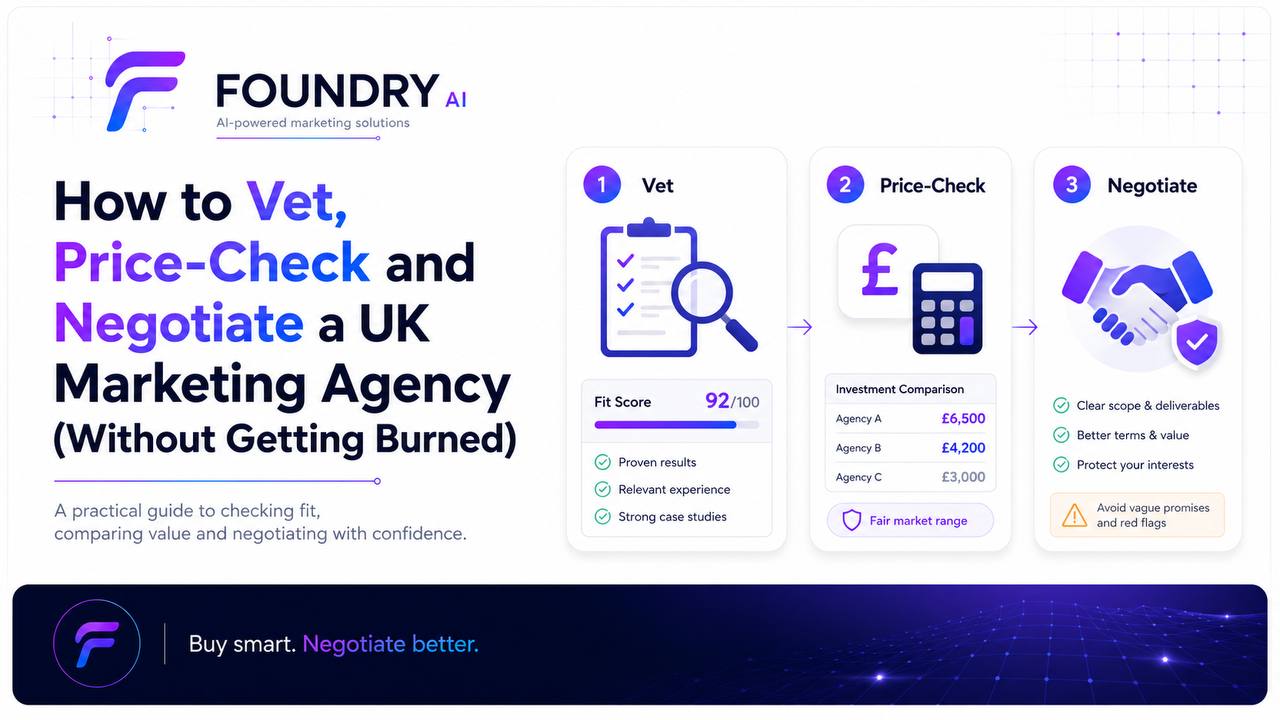
The short answer
Before signing with a UK marketing agency, check five things: published scope, contract length, who actually does the work, who owns your accounts, and what happens to a lead after it comes in. That last one is the line item most buyers, and most vetting guides, forget to ask about.
Choosing an agency is mostly treated as a pricing decision. It's really a due-diligence decision, and most of the questions that matter have nothing to do with the number on the quote.
Questions to ask before you sign
Is the setup fee justified? Setup or onboarding fees typically run £250 to £1,500. Ask specifically what it covers, an audit, account access setup, initial strategy work, and whether it's waived on a longer contract. A fee with no explanation is a red flag; a fee with a clear scope usually isn't.
Is percentage-of-ad-spend pricing being used, and is it fair? This model (typically 10 to 20% of media budget) rewards spend over performance. If it's on the table, ask for it to be paired with reporting on lead quality and conversion rate, not just spend and volume.
Who owns the ad accounts? Your Google Ads, Meta Ads and analytics accounts should be owned by your business, with the agency given access, not the other way round. If an agency insists on owning the accounts themselves, switching providers later becomes far harder and riskier than it should be.
Is delivery senior, or junior/offshore hidden behind a senior pitch? Ask directly who will be doing the day-to-day work, not just who's in the pitch meeting. It's reasonable for junior team members to do execution under senior oversight, it's not reasonable for that to be hidden.
The 90-day / 30-day contract standard
The modern best-practice contract structure is a 90-day initial commitment, followed by 30-day rolling cancellation. This gives a fair amount of time for a baseline to be established and initial work to show leading indicators, without locking you into a full year if it clearly isn't working.
Red flags worth walking away from:
- Guaranteed rankings, leads or ROAS, no credible provider can guarantee outcomes that depend on a platform (Google, Meta) they don't control
- Vague deliverables like "we'll increase your visibility" with no specific, checkable output
- A 12-month lock-in with no break clause and no clear reason for the length
- No clean offboarding process described upfront, ask what happens to your accounts, data and assets if you leave
VAT and hidden-cost checklist
Run through this before you compare two quotes as if they're the same thing:
A non-VAT-registered supplier can quote without adding VAT, while a VAT-registered supplier normally adds the standard rate. That changes the cash price for buyers who cannot reclaim VAT, but it does not by itself indicate better value.
Agency vs freelancer vs in-house
| Typical cost | Best fit | |
|---|---|---|
| Freelancer | £300 to £700/month | Single-channel focus, tighter budgets, more hands-on involvement needed from you |
| Small/boutique agency | £750 to £1,200/month | A small team covering more than one channel, still founder-accessible |
| Full agency | £1,200 to £10,000+/month | Broader capability, dedicated account management, less day-to-day involvement needed |
| In-house hire | ~£65k to £70k/year loaded cost for a £50k salary | Deep, ongoing focus on one function; can't realistically cover multiple specialisms alone |
The line item almost everyone forgets: what happens after the enquiry lands
Most vetting guides stop at the marketing channel itself. But a huge amount of marketing spend is wasted not on the channel, the SEO, the ads, the content, but on what happens after someone actually enquires. A slow reply, no CRM routing, no after-hours coverage: the lead the channel just paid to generate quietly goes cold.
This is the practical version of the Get Recommended stage, and it's worth asking any provider directly what their answer is to "what happens when someone enquires outside office hours, or when your team is slow to reply?" Connected follow-up systems, 24/7 answering, lead qualification, booking, exist specifically to close this gap. Hello Foundry's own Sales & Follow-up service and its Hire Rosie AI receptionist (24/7 AI-answered enquiry handling from £249/month) are one concrete example of what this looks like when it's built in rather than left as an afterthought, worth using as a benchmark question for any provider you're evaluating, whether or not you use that specific one.
A one-page vetting checklist
FAQ
Is digital marketing more expensive in London than the rest of the UK? London agencies often quote more than regional providers, but there is no dependable universal premium. Compare the actual scope, seniority and ownership model rather than assuming postcode predicts quality.
Can I hire an agency for a single project instead of an ongoing retainer? Yes, project or fixed-fee pricing (typically £1,500 to £15,000 depending on scope) is a reasonable way to test a provider on a defined piece of work, such as a website build, before committing to a retainer.
What's a fair notice period if I want to switch agencies? Thirty days of notice after an initial 90-day commitment is a buyer-friendly benchmark, not a universal market rule. Anything requiring more than 30 days' notice on an ongoing basis is worth questioning.
Should I be worried if an agency won't publish their prices? Not necessarily, unpublished pricing often means you're buying judgement and strategy rather than a templated deliverable, which is a legitimate model. It's worth asking why, and comparing the answer against what you actually need.
How do I know if a "free audit" is genuinely useful or just a sales pitch? A genuinely useful audit gives you specific, checkable findings you could act on even without hiring the provider. A sales-pitch audit stays vague and pushes quickly toward a signature.
Sources and methodology
Market-price ranges combine published provider prices and third-party surveys. Published-price samples skew toward productised, lower-cost offers. They are useful benchmarks, not guaranteed quotes for every scope.
Next step
Compare the scope before you compare the price.
Hello Foundry publishes its pricing, delivery model and service scope so you can judge the fit before speaking to anyone.