
The short answer
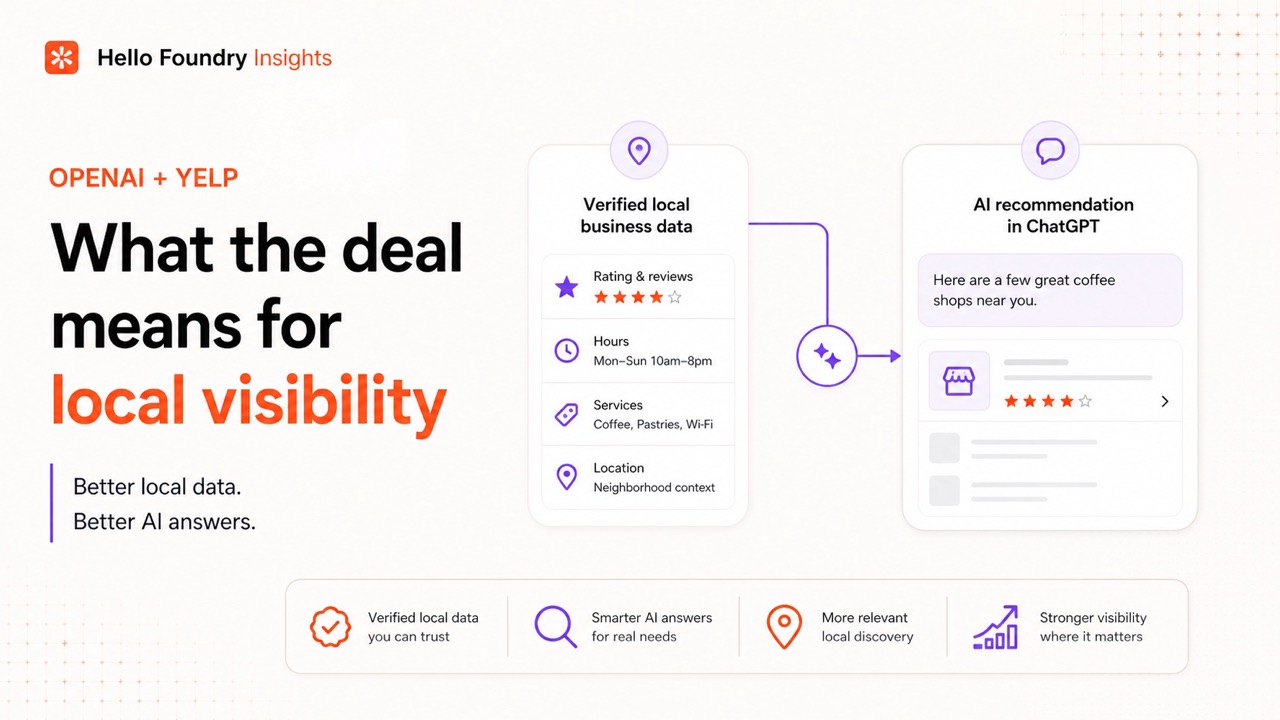
OpenAI has signed a non-exclusive data-licensing agreement with Yelp, giving ChatGPT a direct source of reviews, ratings, photos and information covering millions of local businesses. The agreement is confirmed; the experience is still described as rolling out, and Yelp's Request-a-Quote flow is coming later. The practical response is not to optimise Yelp in isolation. It is to make your business accurate, credible and consistent across the local-data sources AI systems use.
What has actually been announced?
On 23 July 2026, Axios reported that Yelp had licensed its reviews, ratings, photos and business information to OpenAI. Search Engine Land reported that Yelp branding and links will accompany Yelp content when it appears, while OpenAI controls how the experience is presented.
This is a data partnership, not a ChatGPT plugin or app that a customer has to invoke. It is also non-exclusive: Yelp remains free to distribute its data through other search, mapping and AI products.
The numbers explain why the deal matters. Yelp says its corpus includes more than 330 million cumulative reviews, roughly 500 million photos and more than eight million business listings. That gives ChatGPT a substantial structured source for local recommendations.
But announcement is not the same as complete rollout.
Confirmed
- The licensing agreement exists.
- OpenAI can use Yelp reviews, ratings, photos and business information.
- Yelp attribution and links are expected when its content is used.
- The deal is non-exclusive.
Announced, but still rolling out
- The precise go-live timetable across ChatGPT experiences, markets and categories.
- The final presentation of Yelp information inside local answers.
- Yelp's Request-a-Quote flow inside ChatGPT, which launch coverage described as coming soon.
Not confirmed
- A public ranking formula for local businesses inside ChatGPT.
- That Yelp replaces Google Business Profile, Foursquare, Bing, Apple Maps or a business website.
- That buying Yelp advertising guarantees inclusion in an organic ChatGPT answer.
Treat the deal as a new distribution layer for local evidence, not a ranking shortcut.
Why this matters for local businesses
Local recommendations are difficult because the answer has to reconcile live facts. "What is a root canal?" can be answered from reference material. "Which dentist near me treats nervous patients and opens on Saturday?" requires location, service, availability and reputation evidence.
A useful answer has to establish:
- whether the business exists at the stated location;
- whether it provides the requested service;
- whether its hours are current;
- whether recent customers describe the experience the user wants;
- whether enough independent sources agree to support a recommendation.
Yelp's value is not simply the star rating. Review text can contain the attributes that make one business relevant to a specific request: "good with nervous patients", "wheelchair accessible", "fast emergency appointment" or "quiet place to work".
A category and postcode may help a business qualify. Specific, current and corroborated evidence helps it become a plausible answer.
Yelp is important. It is not the whole local stack
The wrong reaction is to abandon everything and go all-in on Yelp.
ChatGPT already draws on a wider local-information stack. Foursquare has a formal OpenAI Places partnership; Bing's web index helps surface crawlable business pages and third-party sources; websites, directories and review platforms provide corroborating evidence. Google Business Profile remains central to Google Search, Maps and Google's own AI experiences.
Practitioner analyses often estimate that Foursquare supplies a large share of the local entities shown in ChatGPT. OpenAI does not publish a definitive source weighting, so treat those percentages as directional, not a ranking specification.
Independent citation research also shows why platform context matters. A Foundation Marketing and AirOps analysis of more than 28 million AI responses found Yelp was the most-cited local-discovery platform across ChatGPT, Gemini, Perplexity and Google AI Mode in Q4 2025. But most Yelp citations came from Google AI Mode and Perplexity. Yelp was only third among the measured local directories on ChatGPT itself.
That makes the strategic logic of the OpenAI agreement clear: it strengthens a previously weaker direct route into ChatGPT. It does not erase the rest of the ecosystem.
Build a multi-platform foundation
Start with the sources most likely to establish the business as one clear entity:
- Foursquare. Claim the listing and correct the category, location, website, hours and contact data.
- Yelp. Complete the profile, services, attributes, photos and Request-a-Quote settings where available.
- Bing Places. Claim or import the business and check the resulting details rather than assuming the import is clean.
- Apple Business Connect. Correct the place card, hours, contact details and imagery.
- Google Business Profile. Keep the profile complete because Google remains the dominant local discovery environment for many businesses.
- Your website. Publish clear service, location, team, proof and contact information, supported by LocalBusiness structured data.
Use one canonical name, address and phone format. The punctuation matters less than whether every profile unmistakably describes the same real business. Remove duplicate listings and correct stale hours, services and URLs.
If the sources agree, an answer engine has a cleaner entity to understand. If they conflict, confidence falls.
The review policy trap
Do not run one review campaign across every platform.
Google permits businesses to ask customers for reviews, provided they do not gate the request by asking only happy customers or offering incentives for positive sentiment.
Yelp takes a different position. Its published guidance tells businesses not to ask customers for Yelp reviews. Solicited reviews may be filtered, and manipulative activity can trigger consumer warnings.
The safe operating model is:
- ask all eligible customers neutrally for Google feedback, without gating;
- do not solicit Yelp reviews;
- make the Yelp profile complete and let genuine Yelp users review organically;
- respond professionally on both platforms;
- never script review wording, buy reviews or reward positive sentiment.
Detailed reviews can contain useful service and location context, but that detail must come from the customer. Manufacturing keyword-rich review copy is both risky and untrustworthy.
What Yelp cannot fix for you
A complete listing cannot compensate for a weak proposition, poor service or thin first-party information.
If the website never explains services, prices, locations, qualifications or the next step, answer engines still have less evidence to work with. If reviews expose a recurring operational problem, the solution is operational. If calls go unanswered, more visibility only creates more missed opportunities.
The commercial chain still has four jobs:
- Be discoverable. Appear in the sources customers and answer engines use.
- Be understandable. Make services, locations and suitability clear.
- Be credible. Support claims with reviews, proof and consistent details.
- Be responsive. Turn the enquiry into a useful customer conversation.
The OpenAI and Yelp deal strengthens the first three. Request-a-Quote may eventually create a new route into the fourth, but it is not yet a substitute for a working response process.
A practical 30-minute audit
Use one real customer query, not a broad category. For example:
"Find an emergency dentist near Milton Keynes that treats nervous patients and is open on Saturday."
Then check whether your public information supplies every part of the answer:
| Evidence needed | Where to check |
|---|---|
| Emergency dentistry is offered | Service page, Yelp, Foursquare and major directory categories |
| The location or service area is accurate | Website, Yelp, Foursquare, Bing, Apple and Google |
| Saturday hours are current | Every material profile and the website |
| Nervous patients are genuinely supported | Service copy, policies and relevant customer reviews |
| The business is credible | Recent reviews, qualifications, team details and independent mentions |
| The next action is obvious | Working phone, booking form and response process |
Any missing or conflicting field becomes a specific task. That is more useful than asking whether the business has "done AEO".
Measure the result, not the profile update
Create a small benchmark set of real buyer prompts:
- "best [service] in [city]";
- "[service] near me open Saturday";
- "[provider] for [specific need] in [city]";
- "compare [business] with [competitor]".
Run the same prompts monthly in ChatGPT, Perplexity, Gemini and Google AI Mode. Record whether the business is named, linked or cited, which source is used, and whether the information is accurate.
Also track:
- profile completeness and consistency;
- review recency, depth and recurring themes;
- first-party coverage of high-intent questions;
- AI referral traffic where measurable;
- branded search, calls and direct enquiries;
- response time, lead quality and booked outcomes.
AI answers vary between runs and users, so a single prompt is not proof of ranking. Look for repeated patterns across a stable prompt set.
Frequently asked questions
Are Yelp reviews already live in every ChatGPT local answer? No. The agreement is confirmed, but launch coverage described Yelp content as something ChatGPT will surface and the rollout timetable was not specified. Treat it as announced and rolling out, not universally live.
Will users have to ask ChatGPT to search Yelp? No. This is a background data-licensing arrangement, not a Yelp app the user must invoke. Where the integration is active and relevant, ChatGPT can use Yelp information in a local answer with attribution.
Does a high Yelp rating guarantee ChatGPT visibility? No. OpenAI has published no local ranking formula or guarantee. Relevance, location, data quality, review detail and corroborating sources may all affect whether a business is useful for a particular query.
Should UK businesses care about Yelp? Yes, but proportionately. Yelp has a stronger consumer footprint in the United States. UK businesses should complete material profiles while continuing to prioritise Google, Bing, Apple, Foursquare, relevant industry directories and their own website.
Should I ask customers for Yelp reviews? No. Yelp's published guidance says businesses should not ask customers for Yelp reviews. Use a platform-specific programme: neutral, non-gated requests are permitted on Google; Yelp reviews should accrue organically.
Is Request-a-Quote inside ChatGPT live? Launch coverage described quote requests as coming soon. Service businesses should complete their Yelp lead settings now, but should not claim that the ChatGPT quote flow is already universally available.
Does Yelp advertising improve inclusion in ChatGPT answers? There is no confirmed organic ranking rule tying Yelp ad spend to ChatGPT inclusion. Yelp has published an advertiser case study showing correlation in a controlled campaign, but that is not an OpenAI ranking specification or a general guarantee.
What should I fix first? Correct inaccurate business details across Foursquare, Yelp, Bing, Apple, Google and your own site. Then strengthen service information, recent customer proof, practical answers and the enquiry path.
Sources and methodology
This analysis separates the confirmed licensing agreement from the rollout and from inferred ranking behaviour. OpenAI has published no local ranking formula. Third-party citation studies and advertiser case studies are presented as directional evidence, not universal guarantees.
Next step
Make your business easier to verify.
Hello Foundry connects listings, reviews, first-party answers and local proof into one measurable visibility system.