
The short answer
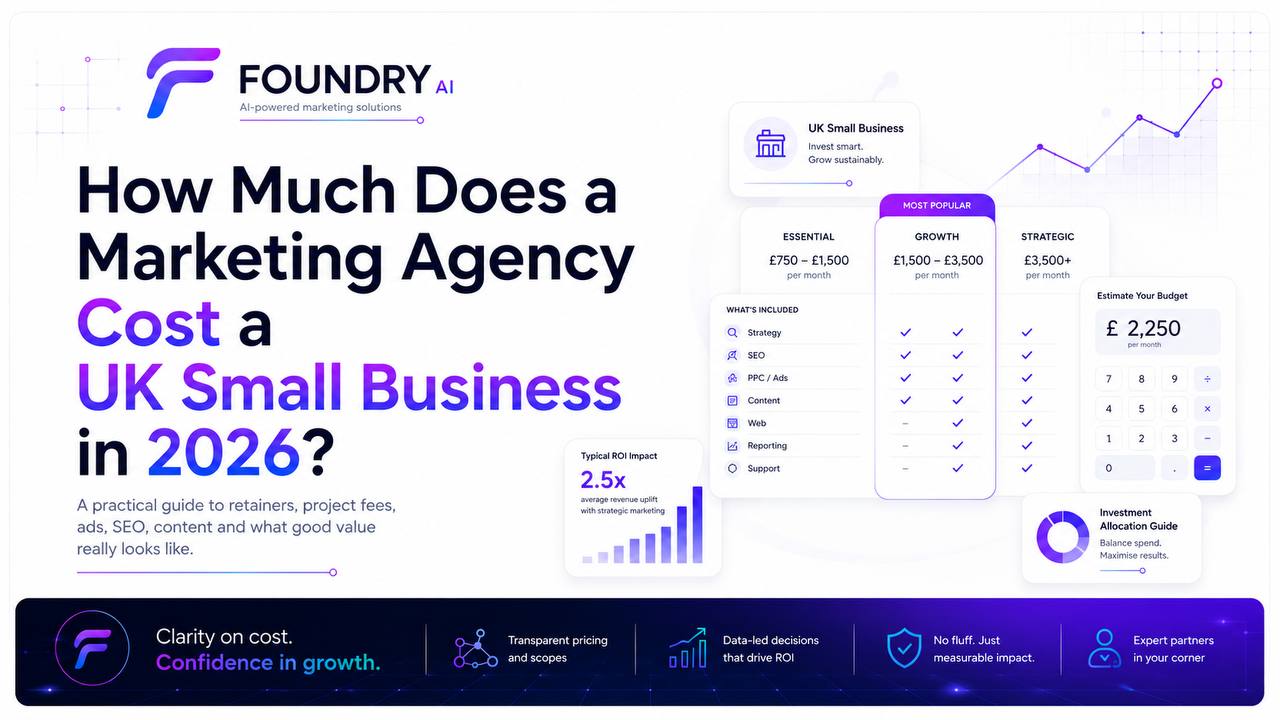
Marketing agency cost for a UK small business runs roughly £350 to £1,500 a month for a properly defined specialist channel, £1,200 to £3,500 for broader agency support, and £3,500 to £10,000 or more for a genuine multi-channel team. The headline number is only useful when the scope, seniority, VAT treatment, media spend and delivery model are shown beside it. This report compares real published prices from named UK providers, including Hello Foundry, so buyers can judge the market for themselves.
The market in one minute
Most agency-pricing articles give a broad range, say "it depends", then send you to a form. This report takes the opposite approach.
It uses prices visible on providers' own public websites. Every named price links to its source. Hello Foundry appears in the same comparisons as everyone else and is not given a score, badge or preferred position.
The useful findings are:
- Entry-level productised services can start below £100 a month, but often buy a narrow or highly standardised scope.
- A properly resourced specialist channel commonly sits between £350 and £1,500 a month for a small business.
- Broader retainers start around £1,200 a month and rise quickly with seniority, production volume and the number of channels.
- Full-service work can cost £3,500 to £10,000 or more each month.
- Ad spend, software, production, VAT and setup fees are frequently charged separately.
- The cheapest headline price is rarely the cheapest comparable service.
Disclosure: Hello Foundry produced this report and sells several of the services compared below. Our prices are included on the same basis as every other provider: public source, visible scope, no favourable scoring. Prices were checked on 27 July 2026.
Typical monthly cost by delivery model
| Delivery model | Typical published range | What the buyer is usually purchasing |
|---|---|---|
| Freelancer or solo specialist | £300 to £700 | One person's time and expertise, usually focused on one channel |
| Small or boutique agency | £750 to £1,500 | A small team, often with direct founder or senior involvement |
| Mid-tier agency | £1,200 to £3,500 | Broader capability, account management and more implementation capacity |
| Full-service agency | £3,500 to £10,000+ | Multiple specialists, senior strategy, production and several connected channels |
| Connected AI-and-human provider | From £399 for one service; from £2,000 for a connected package | AI-assisted research and operations with human oversight across one or more services |
These bands are not quality rankings. A focused freelancer can outperform a large agency on a narrow brief. A larger team becomes useful when the problem genuinely crosses several disciplines.
Named UK providers with published prices
The providers below publish enough information to create a useful starting benchmark. The offers are not identical, so the scope note matters as much as the price.
| Provider | Public starting price | Service and scope note |
|---|---|---|
| Wrise | £99/month + VAT | Entry SEO package based on a small allocation of monthly hours |
| 99social | £99/month | Productised social media management |
| Get Your Website Seen | £199/month | Published SEO packages for smaller businesses |
| Iconic Digital | £299/month | Entry social media service |
| Studio 36 Digital | £399/month + VAT | Published SEO packages rising with activity and scope |
| Birmingham Local SEO | £349/month | Local SEO packages with higher tiers for broader work |
| Hello Foundry: Local Visibility | £399/month ex VAT | Google Business Profile, listings, reviews and local proof |
| Hello Foundry Paid Media | From £497/month ex VAT | Management price; media spend is separate and scope follows a readiness check |
| Hello Foundry Social Media | £499/month ex VAT | Distribution, scheduling and community handling |
| Hello Foundry SEO and AEO | £549/month ex VAT | Search visibility and answer-engine readiness in one service |
| Blue Square Management | £640/month | Published local SEO pricing that rises by tier |
| The Doers | £750/month + VAT | Social packages with substantial production options at higher tiers |
| The Good Marketer | £825/month | Published starter package |
| Urban Soul Design | £950 one-off | Five-page bespoke website package |
| Social Surge | £1,000/month | Google Ads management; combined-channel packages cost more |
| Byter Digital | £1,500/month | Published multi-service package |
| PPC Chief | £1,500/month | Paid-search management; ad spend remains separate |
| Hello Foundry Content Engine | £997/month ex VAT | One researched story developed into a connected monthly campaign |
| Hello Foundry Sales and Follow-up | From £1,250/month ex VAT | Enquiry response, qualification, CRM routing and reactivation |
| Whitehat SEO | £1,967/month | Published SEO starting price; other disciplines priced separately |
| Unavoidable Marketing | £1,900/month + VAT | Published bundled digital marketing package |
| Sample Digital Lab | £2,475/month | Published higher-capacity digital package |
| Hello Foundry Always-On Marketing | £2,000/month ex VAT | SEO and AEO, local visibility, content and email working from one plan |
| EclickPro | £4,500/month | Published full-service package |
| MKM Digital | £8,000/month | Published scale package |
This is not a league table. It is a set of visible reference points. Providers that do not publish prices are absent, which means the sample naturally contains more productised and entry-level offers than the whole UK agency market.
SEO and AEO prices
SEO has one of the widest price ranges because the same label covers radically different amounts of work.
| Provider | Entry price | Highest published tier or scope |
|---|---|---|
| Wrise | £99/month + VAT | £499/month + VAT |
| Get Your Website Seen | £199/month | £400 to £800/month for heavier work |
| Studio 36 Digital | £399/month + VAT | £999/month + VAT |
| Hello Foundry | £549/month ex VAT | £1,299/month ex VAT |
| Whitehat SEO | £1,967/month | Scope priced from its published starting point |
The practical bands are:
- Below £300 a month: usually automated, tightly templated or limited-hour work.
- £350 to £1,000 a month: a mainstream small-business cycle covering priorities, implementation and reporting.
- £1,500 to £5,000 or more: greater capacity, senior strategy, competitive markets or larger websites.
Ask how many hours or delivery units the fee buys, who decides the priorities, whether implementation is included, and whether content or links are charged separately.
Local SEO and Google Business Profile prices
| Provider | Entry price | Higher published tier |
|---|---|---|
| Birmingham Local SEO | £349/month | £999/month |
| Hello Foundry: Local Visibility | £399/month ex VAT | £999/month ex VAT |
| Blue Square Management | £640/month | £2,560/month |
| Unavoidable Marketing | £750/month + VAT | £950/month + VAT for broader local SEO |
Extra locations are commonly charged separately. Hello Foundry's published additional-location price is £199 per location per month. Other providers use their own location, citation and workload rules.
PPC and paid-media management prices
Media spend is not included in the management prices below.
| Provider | Entry management price | Higher published tier |
|---|---|---|
| Hello Foundry Paid Media | From £497/month ex VAT | Scales with budget, channels, locations and creative volume |
| Whitehat SEO | £780/month | Scope dependent |
| Social Surge | £1,000/month | £2,250/month for combined work, including VAT where stated |
| PPC Chief | £1,500/month | £2,500/month |
Percentage-of-spend pricing, often around 10 to 20%, needs careful interrogation. It can be reasonable where workload scales with the account, but it also pays the manager more when spend rises. Pair it with lead-quality, conversion and contribution-margin reporting.
Social media management prices
| Provider | Entry price | Higher published tier |
|---|---|---|
| 99social | £99/month | Productised entry offer |
| Gray Media | £99/month | £995/month |
| Iconic Digital | £299/month | Custom scaling |
| Hello Foundry Social Media | £499/month ex VAT | £1,199/month ex VAT |
| The Doers | £750/month + VAT | Higher tiers include substantial asset production |
Check whether strategy, copy, design, video, community replies, approval handling and reporting are included. "Twelve posts" tells you the quantity, not whether anyone will notice or act on them.
Content and email marketing prices
Content is difficult to compare because many agencies quote by format, research depth or production cycle.
Published UK market guidance commonly places individual articles around £150 to £500 and managed programmes around £1,000 to £3,000 a month. Hello Foundry's Content Engine starts at £997 a month ex VAT for a monthly researched campaign cycle.
Email has a similar scope problem:
| Provider | Entry price | Higher published tier |
|---|---|---|
| Mailing Manager | £40/month + VAT | £120/month + VAT |
| Reposition | £250/month | £1,000+/month |
| The Smart Content | £280/month | £840/month |
| Hello Foundry Email Marketing | From £497/month ex VAT | Scoped as a connected service |
Ask whether platform fees, list cleaning, automation, copy, design, deliverability work and campaign reporting are included.
Website design and build prices
| Provider | Published price | Commercial model |
|---|---|---|
| Urban Soul Design | £950 one-off | Five-page bespoke website |
| Hello Foundry Website Build and Care | Scoped per site | Project build or ongoing care plan |
Low setup prices can be perfectly legitimate, but calculate the two-year cost. Confirm hosting, maintenance, page count, copywriting, ownership, cancellation and migration terms.
Where Hello Foundry sits
Every Hello Foundry engagement begins with the Digital Business Brain, a £995 one-off audit and approved brief. From there, its standalone services sit mainly in the boutique-agency band:
- Local Visibility starts at £399 a month ex VAT.
- Social Media starts at £499 a month ex VAT.
- SEO and AEO starts at £549 a month ex VAT.
- Content Engine starts at £997 a month ex VAT.
- Sales and Follow-up starts at £1,250 a month ex VAT.
Its Always-On Marketing package starts at £2,000 a month ex VAT and connects SEO and AEO, local visibility, content and email around one approved plan. A higher-capacity Always-On Marketing Plus tier is £3,795 a month ex VAT for businesses that need more implementation volume across the same four services.
That is not automatically better value than a specialist. It is designed for businesses whose problem crosses several channels and where repeating research, approvals and account management across separate suppliers creates waste.
If the requirement is narrow, hire the best-fit specialist. If visibility, proof, follow-up and reporting are breaking in several places, compare the total connected scope rather than one headline line item.
The budget gap most comparisons miss
The SME Marketing Report 2025 says 58% of its respondents spent less than £250 a month on marketing. The report does not publish a sample size, so this is directional evidence rather than a population estimate.
Whito's June 2026 study reviewed 128 published prices from 47 UK providers and found median published prices between £358 and £799 a month across the channels measured.
That gap explains why small-business marketing often feels busy without becoming effective. Split £250 across SEO, social, email, ads and content and each channel receives £50. That does not buy enough skilled time for any one route to compound.
The practical response is not "spend everywhere". It is to fund the most important constraint first. Our Get Found, Get Chosen, Get Recommended framework explains the sequence.
Five checks before comparing any quote
- Normalise VAT. Is the price inclusive, exclusive or silent?
- Separate media and software. Ad spend, email platforms, call usage and specialist tools may sit outside the fee.
- Compare scope. Count deliverables, implementation capacity, locations, channels and production requirements.
- Identify the delivery team. Ask who does the work, their seniority and how much access you receive.
- Check ownership and exit. Your accounts, analytics, creative files and data should remain usable if the relationship ends.
The best comparison question is not "Who is cheapest?" It is "Which proposal buys the clearest useful outcome with the fewest hidden assumptions?"
Frequently asked questions
How much do marketing agencies charge per month in the UK? Published prices range from below £100 for narrow productised offers to £10,000 or more for multi-channel teams. A small business should commonly expect £350 to £1,500 for one defined channel, £1,200 to £3,500 for broader support, and £3,500 or more for genuine full-service work.
Are low-cost agency packages a bad idea? Not automatically. They can work when the requirement is narrow and standardised. Problems begin when a low price claims to include strategy, research, production, implementation and reporting without enough time to do those jobs properly.
Does the cheapest provider offer the best return? Price alone cannot answer that. Compare scope, seniority, implementation capacity, commercial measurement and the quality of the work already produced.
Why do many agencies not publish prices? Some work is difficult to scope until the provider understands the website, market, production requirement and internal team. Quote-only pricing is not automatically a warning sign, but buyers should still receive a specific, checkable scope before signing.
Does London location make an agency better? No. London providers may carry higher overheads, but postcode does not establish quality. Compare the people, method, proof, ownership model and deliverables.
What should a marketing retainer include? At minimum: named deliverables, implementation capacity, an approval process, a reporting cadence, ownership rules and a clear explanation of which commercial problem the work addresses.
Can a business hire an agency for a one-off project? Yes. Fixed-fee work suits websites, audits, strategy projects and campaign launches. It can also test the working relationship before an ongoing retainer.
How often will this report be updated? Hello Foundry checks the public dataset quarterly. Providers can request a factual correction through the contact page. A correction changes the data, not a provider's position, because this report does not rank providers.
Sources and methodology
Hello Foundry produced this report and is also one of the providers compared. We used prices visible on providers’ own public pages, recorded the lowest clearly defined entry price, kept VAT and ad-spend qualifications visible, and did not score or rank providers. Published-price samples naturally favour productised offers and exclude agencies that only quote after discovery. Prices are a point-in-time benchmark, not a substitute for a scoped proposal. We recheck the dataset quarterly and invite corrections.
Next step
See what a connected marketing system costs.
Compare Hello Foundry pricing across search visibility, content, email and 24/7 enquiry handling.