
The short answer
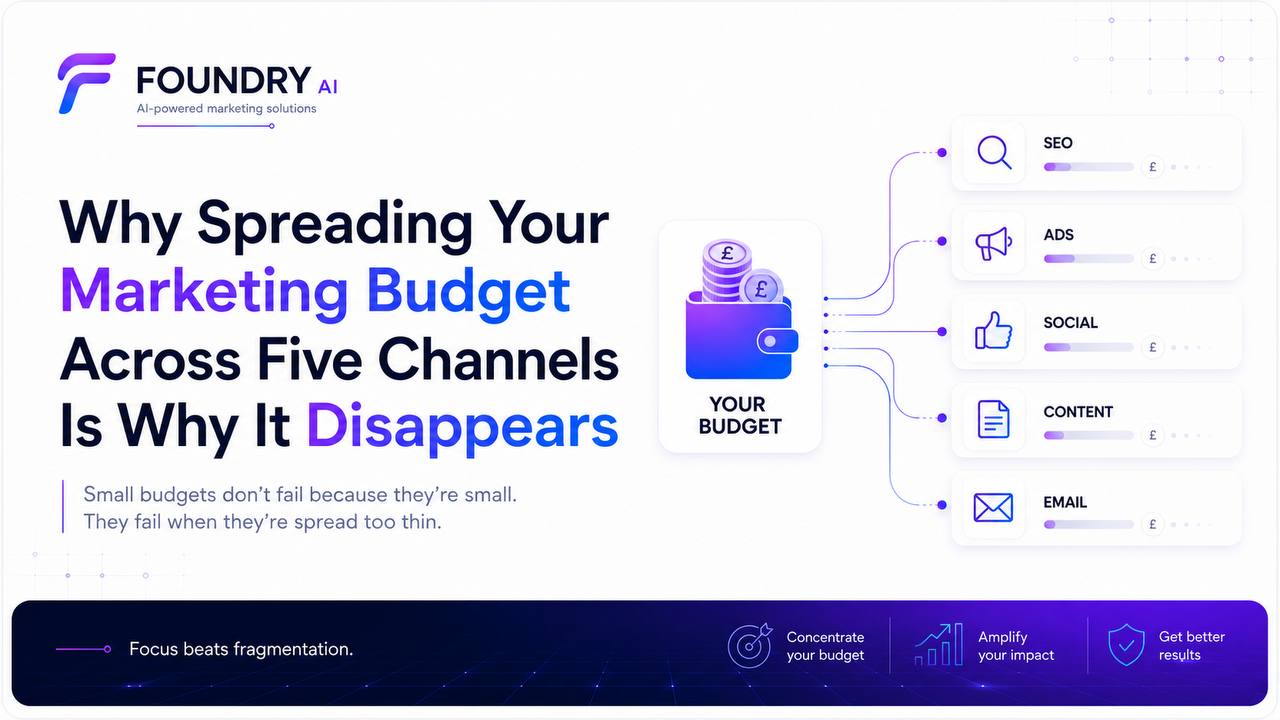
The common advice for a small marketing budget is to run a bit of everything, so nothing is neglected. The data says this is exactly backwards: a budget split five ways buys too little of anything to compound, and the money disappears without a trace. Fund one thing properly instead.
This isn't a criticism of any channel, or of any agency. It's a criticism of a single, very common instinct: when the budget is tight, spread it thin so nothing feels ignored. It feels responsible. It's the single most reliable way to make a small marketing budget achieve nothing.
The myth: "a bit of everything, so nothing's neglected"
It sounds sensible. Cover SEO, run some social, send the odd email, maybe a small ad budget, a diversified portfolio, like investing. The problem is that marketing channels don't work like a diversified portfolio. They work like compound interest: a small amount, properly and consistently applied to one thing, builds on itself. A tiny amount spread across five things resets to zero every month, because none of it is enough to build momentum.
The reality: a ~£250/month budget split five ways gives each channel roughly £50. At typical UK day rates (SEO ~£325/day, social ~£350/day, PPC ~£300/day), £50 doesn't buy meaningful skilled time on any of them, it buys automation, templates, or a few minutes of someone's attention. Nothing compounds at that level.
Myth: "cheaper is safer"
The instinct makes sense, if you're not sure marketing will work, why risk more than the minimum? But a ~£300/month SEO package buys roughly one day of a competent freelancer's time, once a month. One day a month is not enough to move a competitive keyword, however good the freelancer is. The cheapest retainer is very rarely the cheapest outcome, it's often the most expensive way to achieve nothing, because you're still paying every month for work that never reaches critical mass.
Myth: "one hire can replace an agency"
A single marketing hire, however good, cannot simultaneously be a technical SEO specialist, a paid media buyer, a content writer, a social media manager and a data analyst. Something will always be the thing they're worst at and do least, usually the technical or analytical end, because it's the least visible day to day. This isn't a knock on in-house marketers; it's simple maths about what one person's time can cover.
Myth: "percentage-of-ad-spend pricing is risk-free"
It feels aligned, the agency only earns more if you spend more. But that's exactly the problem: it's aligned with spending, not with results. A percentage-of-spend fee structure gives the agency no direct incentive to spend less for the same outcome. If you use this model, it's worth pairing it with independent reporting on lead quality and conversion, not just spend and click volume.
The evidence-grounded alternative
None of this means small budgets are hopeless, it means they need sequencing, not spreading. The order that holds up under the day-rate maths is Get Found, then Get Chosen, then Get Recommended, fully fund visibility first, then conversion and trust, then follow-up and retention, rather than touching all three lightly at once. The full framework is set out here.
This isn't a house opinion dressed up as data. It follows directly from the day-rate numbers above: any given pound only does useful work once it crosses the threshold where it buys meaningful skilled time on one thing. Below that threshold, spreading it further doesn't protect you from wasting it, it guarantees you'll waste all of it.
Where AI scaffolding changes the economics
Part of why fragmentation has been the default for so long is that funding one channel "properly" has traditionally meant paying for a dedicated specialist's full attention, expensive at small-business scale. AI-assisted research, drafting and monitoring is one of the genuine forces currently lowering that floor, letting a smaller connected team properly resource a channel at a price point that used to only buy a fraction of one. That's an observation about where the market's heading, not a pitch for any particular provider.
FAQ
But don't I need at least some social media presence, even if I can't fund it properly? A dormant, unattended profile is often worse than no profile, it signals inactivity to anyone who checks. If you can't fund social properly yet, a simple, honestly "not actively managed" presence with basic information is a more defensible minimum than thin, inconsistent posting.
Isn't diversification generally good financial advice, why doesn't it apply here? Investment diversification spreads risk across assets that don't need ongoing input to hold their value. Marketing channels require sustained, threshold-level effort to produce any return at all, below that threshold, there's no "safe minimum return," there's just no return.
What if my budget genuinely can't cover one channel at the mainstream rate? Start with the free foundations (a working website, a complete Google Business Profile) before spending anything, these cost time, not money, and are prerequisites for any paid channel to work. Once those are solid, save toward properly funding one channel rather than thinly running several.
Does this apply to project work too, or just retainers? The same logic holds for one-off projects: a £300 "quick SEO fix" project buys less useful work than saving toward a properly scoped audit and implementation project a few months later.
Sources and methodology
Market-price ranges combine published provider prices and third-party surveys. Published-price samples skew toward productised, lower-cost offers. They are useful benchmarks, not guaranteed quotes for every scope.
Next step
Stop splitting the budget before it can work.
Start with the visibility, conversion or follow-up job that is currently costing you the most.