
The short answer
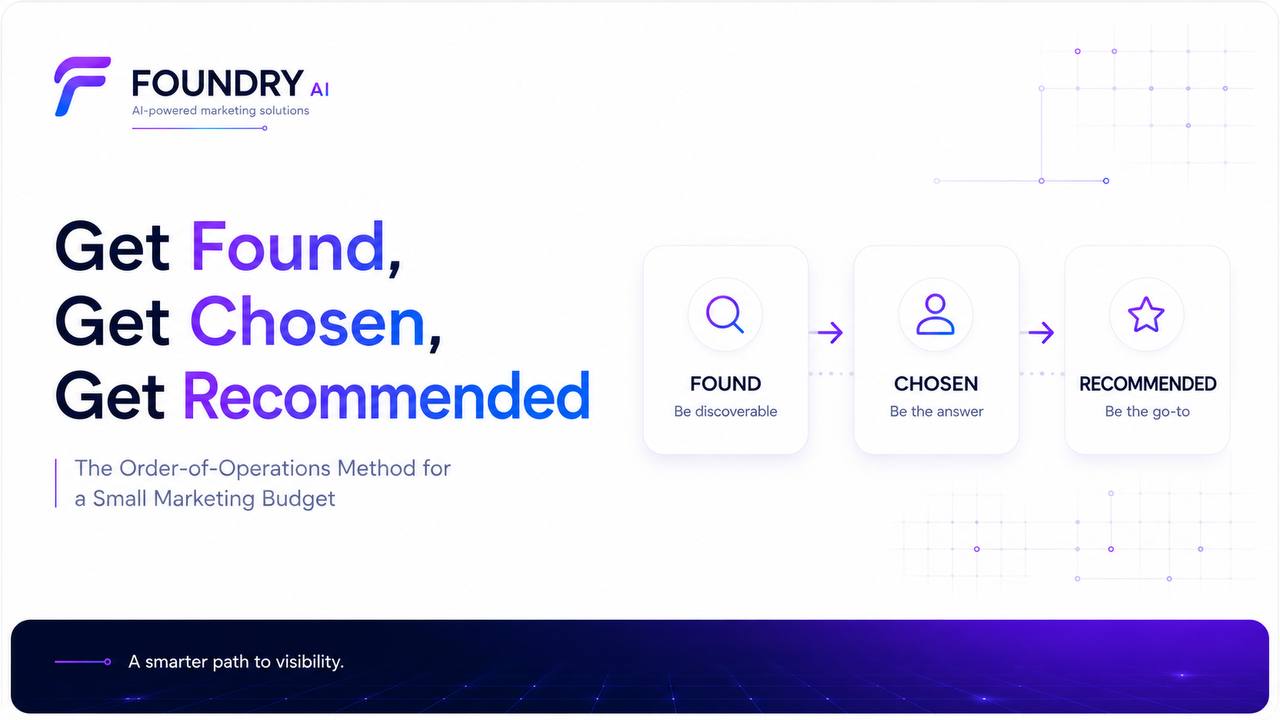
A small marketing budget doesn't fail because it's small. It fails when it's split across everything at once instead of fully funding one stage before moving to the next. Spend in this order: Get Found, then Get Chosen, then Get Recommended, fully funding each before adding the next.
Most small businesses approach marketing like a shopping list: a bit of SEO, a bit of social, some email, maybe some ads if there's budget left. It feels balanced. It's actually the reason nothing works. A £500/month budget split five ways buys £100 of work per channel, not enough for anything to compound. The fix isn't a bigger budget. It's a different order.
The three stages
1. Get Found, visibility. Before anything else, fix what's free or cheap: a working website, a complete Google Business Profile. Then fully fund the one channel that gets you found, usually local SEO or search visibility, properly, rather than thinly. There's no point building the next two stages if nobody can find you in the first place.
2. Get Chosen, trust and conversion. Once you're being found, the budget moves to what makes you the obvious choice once someone lands on your site or profile: proof, reviews, a website that actually converts, content that answers the questions a buyer is really asking. Traffic without conversion is just an expensive number on a dashboard.
3. Get Recommended, retention and referral. Once found and chosen are both working, budget moves to what turns a customer into a repeat customer and a referrer: fast follow-up, email nurture, reactivation of past enquiries. This is the stage almost everyone skips, and it's usually the cheapest one to fund relative to its return, most businesses are sitting on old enquiries and past customers they've simply stopped talking to.
Stage 1 in detail: Get Found
Start with the free foundations. A Google Business Profile that's fully completed, categorised and up to date costs nothing but time. A website that actually loads properly and states what you do costs little to fix if it's already broken.
Then fund the one channel that gets you found, properly. Use this sanity check before you sign anything: divide the monthly retainer by the relevant day rate for that channel (SEO ~£325/day, social ~£350/day, PPC ~£300/day). If a £500 package implies more than roughly 1.5 days of skilled work a month, ask who's actually doing it, a package that cheap is either automated, junior-delivered, or both.
Stage 2 in detail: Get Chosen
This is proof, content and conversion work, the things that turn a visit into an enquiry. It's tempting to skip straight here because it feels more exciting than technical visibility work, but if nobody can find you yet, there's nothing to convert. Fund this second, once Stage 1 is genuinely working.
Stage 3 in detail: Get Recommended
Follow-up, email nurture, reactivation. Most businesses have a list of past enquiries and customers sitting untouched, Get Recommended is often the cheapest stage to fund because you're not paying to find new attention, you're recovering attention you already paid for once.
When to move to the next stage
Use revenue as a rough guide for total spend, then allocate it across the three stages in order rather than splitting it evenly:
- Start-up (under £100k revenue): 12 to 20% of revenue, weighted heavily toward Get Found
- Build (£100k to £2.5M revenue): 8 to 15% of revenue, starting to balance Get Found and Get Chosen
- Scale (£2.5M+ revenue): 5 to 10% of revenue, with meaningful investment in Get Recommended alongside the other two
The published-vs-quoted rule
One more thing worth knowing before you buy at any stage: if a provider publishes their prices, you're generally buying a defined deliverable at the budget end of the market (roughly a £100 floor). If they won't publish prices and want to "have a conversation," you're buying judgement and strategy, typically an £800 to £1,500 floor. Neither is automatically wrong, but matching the model to your budget and your stage matters. A published-price provider is usually the right fit for a clearly-scoped Stage 1 job; an unpublished-price provider is more often selling the kind of judgement Stage 2 and 3 work benefits from.
Applying the framework: two examples
A £500/month business. Splitting this five ways buys almost nothing anywhere. Applied to the framework: spend the full £500 on Get Found, a properly-run local SEO or visibility programme, for three to six months before touching anything else. Once that's converting search interest into visits or calls, move a portion to Get Chosen.
A £2,000/month business. This is roughly where a connected, properly-resourced approach across all three stages becomes realistic in one budget, if the provider is genuinely efficient rather than stretching a single junior across everything. This is also where connected-system pricing starts to outperform buying three separate specialists, because the research and approval work isn't being repeated three times.
Where connected systems change the maths
The three stages don't have to come from three separate suppliers relearning your business each time. When Get Found, Get Chosen and Get Recommended work share one research and approval cycle, a single stage's budget can effectively cover more ground than the same money split across disconnected providers. Hello Foundry's SEO & AEO and Local Visibility services, for example, share one backlog, so the same page or fix isn't paid for twice across the Get Found stage. It's a structural point about how connected delivery works, not a reason to buy any particular package.
FAQ
What should a marketing retainer include? At minimum: a clear scope of deliverables, a reporting cadence, and clarity on which stage (Get Found, Get Chosen or Get Recommended) the work is actually addressing. Vague language like "increasing visibility" without specifics is a red flag regardless of price.
How long should a marketing contract lock me in for? A buyer-friendly structure is a 90-day initial commitment, then 30-day rolling cancellation after that. Longer lock-ins (12 months) sometimes come with a discount, but reduce your flexibility if the first stage isn't working.
Should I ever fund two stages at once? Once one budget threshold is comfortably covering a stage properly, yes, but avoid splitting a genuinely small budget across two stages before either is properly funded on its own.
Is this framework only for very small businesses? No, the sequencing logic (found, then chosen, then recommended) holds at any budget. What changes with size is how much each stage can be simultaneously resourced rather than sequenced.
What if I've already got a website and a decent Google Business Profile? Then you've effectively completed the free part of Get Found already, the next spend should go on properly funding the channel that gets you found beyond that baseline, rather than starting from scratch.
Sources and methodology
Market-price ranges combine published provider prices and third-party surveys. Published-price samples skew toward productised, lower-cost offers. They are useful benchmarks, not guaranteed quotes for every scope.
Next step
Build the right system for your budget.
Choose the work that needs funding first, then add the next engine when the first is doing its job.